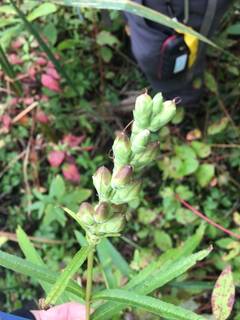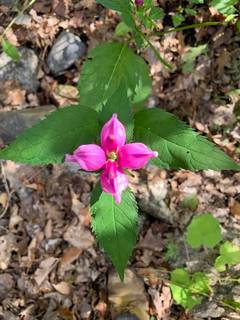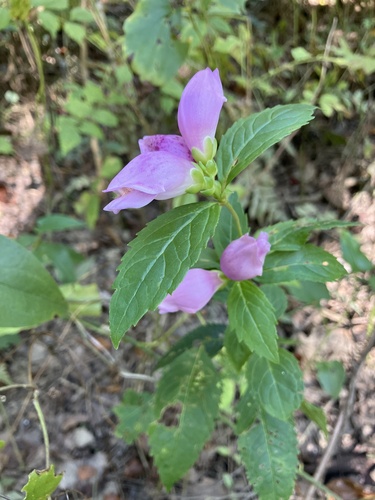
Chelone, Genus, obliqua, Species,
- Genus & species
rose turtlehead
Southeastern United States (Maryland to Florida, west to Mississippi; moist to wet meadows, streambanks, swamp margins, wet woodland clearings)
Overview
Chelone obliqua is an upright clump-forming herbaceous perennial in the plantain family (Plantaginaceae) reaching 24–36 inches (60–90 cm) tall with a spread of 18–24 inches (45–60 cm). Dense terminal spikes 3–5 inches (8–13 cm) long carry hooded two-lipped flowers that resemble a turtle's head with the mouth slightly open — the origin of the common name. Flower color ranges from deep rose-pink to purple-pink. Opposite lanceolate leaves 3–6 inches (8–15 cm) long are dark green with sharply serrate margins. Stems are stiff upright and square in cross-section (characteristic of the family). Bloom runs from late August through October, carrying color through the transition from late summer to fall when many border perennials have finished. The plant spreads slowly by short rhizomes to form expanding clumps. Growth rate is moderate. Hardy to zone 4. The species requires consistently moist to wet soil and does not tolerate drought; it grows naturally as a wetland plant. In dry garden soils the leaves scorch along the margins and the plant declines. The species is the larval host plant for the Baltimore checkerspot butterfly (Euphydryas phaeton), which lays eggs on the foliage; caterpillar damage is part of the ecological function rather than a pest problem to control.
Native Range
Chelone obliqua is native to the southeastern United States, from Maryland south to Florida and west to Mississippi, where it grows in moist to wet meadows, along streambanks, at swamp margins, and in wet woodland clearings.Suggested Uses
Grown in bog gardens, rain gardens, streamside plantings, and moist borders at 18–24 inch (45–60 cm) spacing. The August–October bloom window fills the late-summer-to-fall gap when most border perennials have finished. The species functions as a native pollinator plant and as the larval host for the Baltimore checkerspot butterfly, extending the value in ecological and wildlife-garden plantings. Pairing with Lobelia cardinalis (red cardinal flower), Eupatorium (Joe-Pye weed), and native ferns in moist naturalistic plantings carries a native-wetland color palette through the fall. Dry borders, xeric gardens, and containers without consistent irrigation are not suitable.How to Identify
Appearance
Size & Dimensions
Height2' - 3'
Width/Spread1'6" - 2'
Bloom Information
Dense terminal spikes 3–5 inches (8–13 cm) long of deep rose-pink to purple-pink two-lipped hooded flowers open from late August through October. Bloom duration is 4–6 weeks. Individual flowers open from the bottom of the spike upward, extending the display as new buds replace finished flowers along the spike length.
Detailed Descriptions
Flower Description
Deep rose-pink to purple-pink, two-lipped hooded flowers in dense terminal spikes 3-5 inches longFoliage Description
Dark green, opposite lanceolate 3-6 inches with sharply serrate marginsGrowing Conditions
Sun Requirements
Requires 3-8 hours of direct sunlight daily
• Full Sun: 6+ hours of direct sunlight
• Partial Shade: 3-6 hours of direct sunlight
• Full Shade: Less than 3 hours of direct sunlight
Care & Maintenance
Care Guide
Grows in partial shade to full sun in consistently moist to wet soil at pH 5.5–7.0, tolerating loam and clay. Hardy to zone 4. Boggy conditions are acceptable. Drought is not tolerated; leaf scorch and plant decline occur in dry garden soils. Full sun is tolerated only with reliable irrigation. Pinching the stem tips by about one-third in late May to early June (before flower buds set) encourages branching and produces more compact plants with additional flower spikes and a reduced tendency to flop under flower weight. Slugs may damage young spring foliage and are the main pest concern. No serious disease problems are reported.Pruning
Pinch stem tips by one-third in late May to early June to encourage branching and prevent flopping in the fall bloom period. Cut all dead stems to the ground in late fall after frost or in early spring. Divide clumps every 3–4 years when the center becomes sparse, lifting and splitting the rhizome mass in early spring.Pruning Schedule
Prune: May–June
late spring