Ceratostigma, Genus, spp., Multiple species,
- Genus
- Multiple species
plumbago
Eastern Africa and central and eastern Asia
Overview
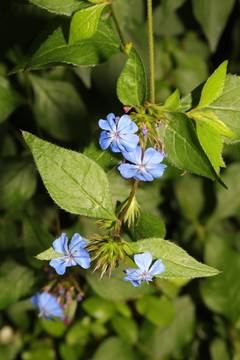
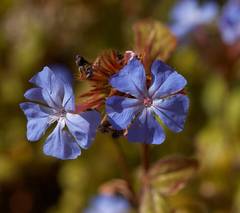
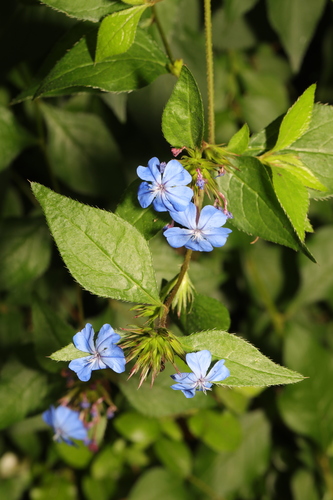
Ceratostigma is a genus of about eight species of deciduous to semi-evergreen shrubs and perennials in the family Plumbaginaceae, native to eastern Africa and central and eastern Asia. They are grown for their blue flowers; the most familiar are C. plumbaginoides, a spreading perennial groundcover 8 to 12 inches (20 to 30 cm) tall, and C. willmottianum, a twiggy shrub 2 to 4 feet (60 to 120 cm) tall and wide. The leaves are simple, oval, 1 to 3 inches (2.5 to 8 cm) long, mid-green through the growing season and often turning red to bronze in autumn. From midsummer to autumn the plants carry clusters of five-petalled flowers in clear cobalt to gentian blue, each about 0.5 to 1 inch (1.5 to 2.5 cm) across, opening from reddish buds. Spent flowers leave bristly seed heads. C. plumbaginoides spreads by underground runners to form a dense mat, while the shrubby species build a rounded twiggy framework. Plants emerge late in spring, so their space looks bare into early summer. Stems may die back in cold winters and resprout from the base.
Native Range
Ceratostigma species are native to eastern Africa and to central and eastern Asia, including the Himalayas, western China, and Tibet. C. plumbaginoides comes from western China, while C. willmottianum is native to western China and Tibet.Suggested Uses
Grown as a late-season groundcover, edging, rock garden plant, and front-of-border filler, with the shrubby species used in mixed and gravel plantings. The blue flowers extend colour into autumn when many plants have finished. They draw bees and butterflies.How to Identify
Appearance
Size & Dimensions
Height8" - 4'
Width/Spread1' - 4'
Bloom Information
Detailed Descriptions
Flower Description
cobalt to gentian blueFoliage Description
mid-green, turning red to bronze in autumnGrowing Conditions
Sun Requirements
Requires 6-10 hours of direct sunlight daily
• Full Sun: 6+ hours of direct sunlight
• Partial Shade: 3-6 hours of direct sunlight
• Full Shade: Less than 3 hours of direct sunlight
Care & Maintenance
Care Guide
Plants grow in full sun to light shade in light, free-draining soil of moderate fertility, across a pH range of about 6.0 to 7.5. Established plants tolerate drought and heat, while wet winter soil causes rot and is the main cause of loss. C. plumbaginoides spreads by runners and can be lifted and divided to control its reach or to propagate it. Plants start into growth late in spring, so the ground looks empty until early summer. A position with reflected warmth, such as a wall base, improves flowering in cooler regions. Stems killed by frost are cut to the ground in spring.Pruning
Cut stems back hard in early spring, since flowers form on new growth. In mild areas the semi-evergreen shrubby species are trimmed lightly to shape, while in cold areas frost-killed stems are removed to ground level. Shearing the perennial groundcover after flowering tidies the mat.Pruning Schedule
Prune: March–April
early spring
Container Growing
Suitable for container growing
Minimum container size: 3 gallons