Cassytha, Genus, pubescens, Species,
- Genus & species
downy dodder-laurel
Overview
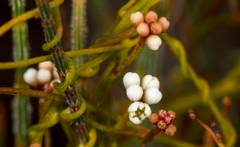
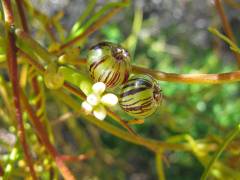
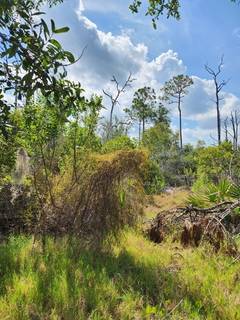
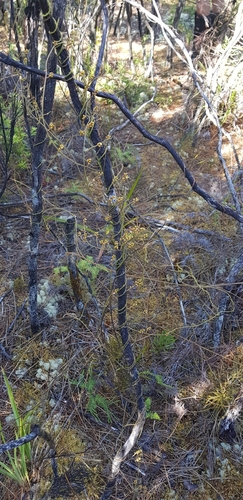
Cassytha pubescens is a parasitic, twining vine that scrambles over shrubs and small trees, attaching to host stems by small sucker-like haustoria that draw water and nutrients. The wiry, thread-like stems are green to orange-brown, 0.02-0.06 inch (0.5-1.5 mm) thick, softly hairy when young, and form tangled masses several feet across over a host canopy. Leaves are reduced to tiny scales, so the green stems carry out most photosynthesis, making the plant a partial rather than total parasite. Small white to cream flowers about 0.1 inch (2-3 mm) across appear in short spikes through much of the year, followed by fleshy green to translucent berries 0.2-0.3 inch (5-8 mm) wide. The vine spreads over and through its host and, in heavy infestations, can shade and weaken the supporting plant. It forms no roots in the soil once established on a host and depends entirely on living host plants.
Native Range
Native to southern and eastern Australia, including New South Wales, Victoria, Tasmania, South Australia, and Western Australia. Grows in heathland, woodland, and forest, draped over a wide range of native shrubs and small trees in coastal and tableland habitats.Suggested Uses
Rarely planted in gardens; it occurs naturally in bushland and remnant vegetation as part of the local plant community. It has been trialled as a native biological control agent on invasive shrubs such as gorse and blackberry. In bush regeneration it is generally left in place except where it threatens specimen or rare host plants.How to Identify
Appearance
Size & Dimensions
Height6' - 15'
Width/Spread3' - 10'
Bloom Information
Flowers through much of the year, with peaks in spring and summer depending on region and host condition. The small cream flowers are borne in short spikes and are easily overlooked among the stems. Berries ripen over several months and may be present at the same time as flowers.
Detailed Descriptions
Flower Description
white to creamFoliage Description
green to orange-brown stems with scale leavesGrowing Conditions
Sun Requirements
Requires 4-10 hours of direct sunlight daily
• Full Sun: 6+ hours of direct sunlight
• Partial Shade: 3-6 hours of direct sunlight
• Full Shade: Less than 3 hours of direct sunlight
Care & Maintenance
Care Guide
As a parasite, it grows only on living host plants and cannot be cultivated in soil alone; it is rarely grown deliberately and is most often managed where it appears on native vegetation. It establishes when seedlings make contact with a suitable host and form haustoria, after which the soil root withers. Heavy growth can shade and stress hosts, so it is cut or pulled from the host canopy where host health is a concern. It tolerates the same coastal and tableland conditions as its hosts, including frost and dry spells, provided the host survives. No fertiliser or watering regime applies, as its resources come from the host. In research settings it has been studied as a biological control on invasive woody weeds, which it parasitises heavily.Pruning
Where control is wanted, the stem masses are cut and pulled away from the host before berries ripen to limit seed spread. Repeated removal over several seasons is usually needed, as fragments and seed re-establish. No pruning applies when it is left in place as part of natural vegetation.Pruning Schedule
Prune: October–December
springsummer