Cassytha, Genus, filiformis, Species,
- Genus & species
laurel dodder
Pantropical coasts including northern and eastern Australia
Overview
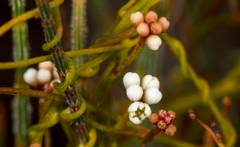
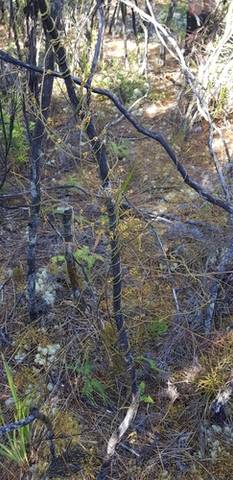
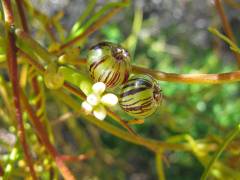
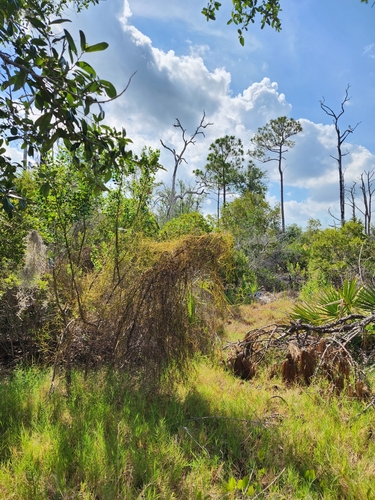
Cassytha filiformis is a parasitic, leafless climbing plant found across tropical and subtropical coasts worldwide, including northern and eastern Australia. It consists of slender, thread-like stems 0.02–0.06 inch (0.5–1.5 mm) thick, yellow-green to orange, that twine over and through other plants in tangled masses. The stems attach to host plants by small sucker-like outgrowths called haustoria, which draw water and nutrients from the host; the plant keeps some chlorophyll and is a partial parasite rather than a fully dependent one. Leaves are reduced to tiny scales. Small white flowers about 0.08 inch (2 mm) across appear in short spikes, followed by rounded, white, fleshy fruits 0.2–0.3 inch (5–7 mm) across. Cassytha filiformis grows mainly on coastal dunes, heath, and scrub, draped over shrubs and groundcovers. Heavy infestations can weaken or smother host plants. It spreads by seed, often carried by birds that eat the fruit, and by stem fragments that re-attach to new hosts.
Native Range
Found across tropical and subtropical coasts worldwide, including northern and eastern Australia, where it is native. It grows on coastal dunes, heath, and scrub, climbing over shrubs and groundcovers.Suggested Uses
Cassytha filiformis is not planted in gardens and has no ornamental use. It is part of the natural coastal vegetation and is used in some regions in traditional medicine. In cultivated settings it is managed as a parasitic weed.How to Identify
Appearance
Size & Dimensions
Height3' - 10'
Width/Spread3' - 10'
Bloom Information
Detailed Descriptions
Foliage Description
yellow-green to orange stemsGrowing Conditions
Sun Requirements
Requires 6-10 hours of direct sunlight daily
• Full Sun: 6+ hours of direct sunlight
• Partial Shade: 3-6 hours of direct sunlight
• Full Shade: Less than 3 hours of direct sunlight
Soil Requirements
Drainageaverage