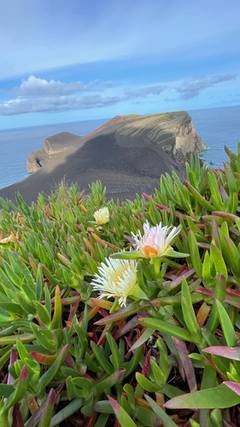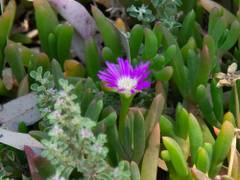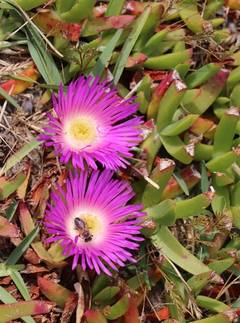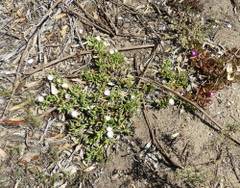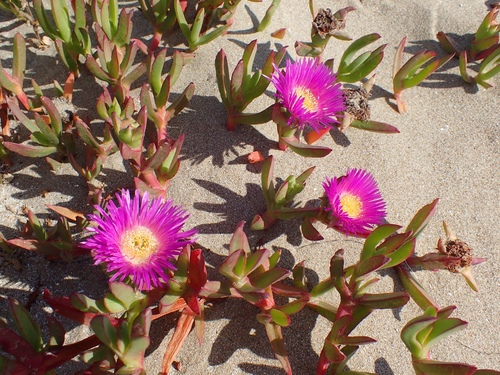
Carpobrotus, Genus, chilensis, Species,
- Genus & species
Chilean sea fig
Overview
Carpobrotus chilensis is a trailing, mat-forming succulent perennial in the ice plant family, growing along coastal bluffs, dunes, and sandy flats. Its prostrate stems root at the nodes and spread 3-6 feet (0.9-1.8 m) or more, building dense mats only 4-6 inches (10-15 cm) deep. The fleshy leaves are triangular in cross-section, 1.5-2.5 inches (4-6 cm) long, bright green to slightly glaucous, and tinged red under strong sun or drought. Solitary flowers 1.5-2.5 inches (4-6 cm) across open by day, with many narrow rose-magenta petals around a center of yellow stamens. Flowering runs through spring and summer. The fleshy, fig-shaped fruit is edible when ripe. The plant is highly drought and salt tolerant and binds loose sand, but it grows aggressively and smothers low-growing native vegetation, and is treated as an invasive weed on parts of the Pacific coast. It is easily confused with the larger Carpobrotus edulis, which has yellow to pale pink flowers and coarser leaves.
Native Range
Found along the Pacific coast of the Americas on bluffs, dunes, and sandy flats from coastal Chile to California; its precise native range is debated, and the California populations are often treated as introduced.Suggested Uses
Used as a coastal groundcover and sand stabilizer on banks and slopes in frost-free climates. The dense succulent mat suppresses weeds and withstands salt-laden wind. Because it spreads into natural dunes, planting is limited to contained urban and garden settings away from wild coast.How to Identify
Appearance
Size & Dimensions
Height4" - 6"
Width/Spread3' - 6'
Bloom Information
Flowering runs from March to August, peaking in spring along the coast. Each rose-magenta flower opens in daylight and closes at night over several days, followed by a fleshy fig-like fruit. Bloom is heaviest where plants get full sun and some winter moisture.
Detailed Descriptions
Foliage Description
green to red-tingedGrowing Conditions
Sun Requirements
Requires 6-10 hours of direct sunlight daily
• Full Sun: 6+ hours of direct sunlight
• Partial Shade: 3-6 hours of direct sunlight
• Full Shade: Less than 3 hours of direct sunlight
Care & Maintenance
Care Guide
Grows in full sun on sandy, rocky, or fast-draining soils and tolerates salt spray, wind, and prolonged drought. It needs almost no irrigation once rooted and takes no fertilizer. A soil pH of 6.0 to 8.0 suits it, and wet, poorly drained ground causes stem and root rot. Propagation is by seed or simply by laying stem segments on soil, where they root within weeks. The same rooting vigor makes it spread beyond its intended area and escape into wild dunes, so containment is the main management issue. It is hardy only in frost-free to light-frost climates and is damaged below about 25 F (-4 C).Pruning
Mats are trimmed back at the edges through the growing season to hold them in place. Cut or pulled stem fragments root readily and are removed from the site rather than left on the soil. Cutting back also opens up old, woody centers for fresh growth.Container Growing
Suitable for container growing
Minimum container size: 2 gallons