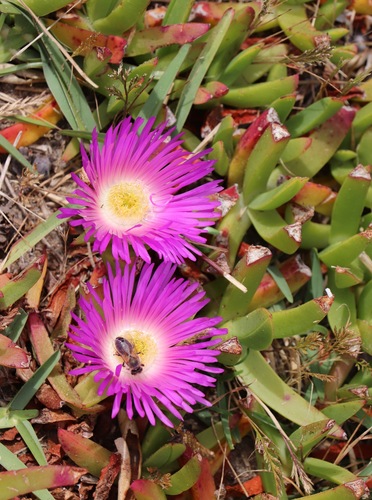
Carpobrotus, Genus, spp., Multiple species,
- Genus
- Multiple species
sea figs
Coastal South Africa, with species in Australia and South America
Overview
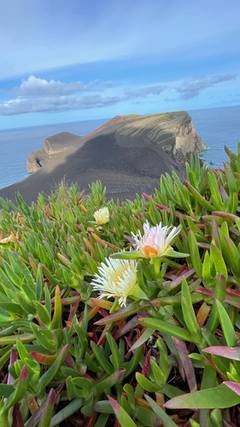
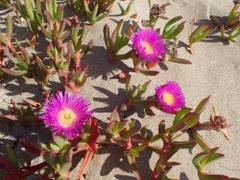
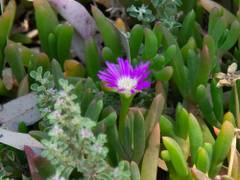
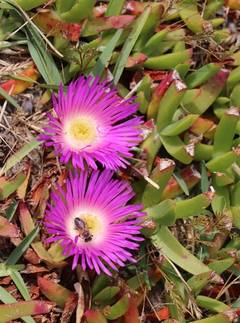
Carpobrotus is a genus of about 12 to 25 species of mat-forming succulent perennials in the family Aizoaceae, native to coastal South Africa with a few species in Australia and South America. The trailing stems root as they spread and form dense mats only 4 to 8 inches (10 to 20 cm) deep but several feet across, clothed in fleshy, three-sided leaves 2 to 5 inches (5 to 13 cm) long. Large daisy-like flowers, 2 to 6 inches (5 to 15 cm) wide, open in magenta, purple, pink, or yellow, made up of many narrow petal-like staminodes that close at night. The flowers are followed by fleshy fig-shaped fruits that are edible in some species, giving the names sea fig and Hottentot fig. The plants withstand sand, salt spray, and drought. C. edulis has naturalized along the coasts of California, the Mediterranean, and Australia, where it smothers native vegetation and is treated as an invasive weed.
Native Range
Carpobrotus is native mainly to the coastal regions of South Africa, with additional species in southern and western Australia and along the Pacific coast of South America. C. edulis, planted widely for erosion control on warm coastlines, has escaped into the wild well beyond its native range.Suggested Uses
Non-invasive Carpobrotus species are grown as drought-tolerant groundcover on banks, coastal gardens, and sandy slopes, spaced 18 to 24 inches (45 to 60 cm) apart to knit together. They suit rock gardens, retaining-wall tops, and large containers where the stems can trail. The plants hold loose sand and tolerate salt where many groundcovers fail.How to Identify
Appearance
Size & Dimensions
Height4" - 8"
Width/Spread6' - 10'
Bloom Information
Flowering peaks in spring and early summer, roughly April to July, with scattered bloom continuing in mild coastal climates. Each flower opens in sun and closes at night over several days. In frost-free regions some flowers appear nearly year-round.
Detailed Descriptions
Flower Description
magenta, purple, pink, or yellowFoliage Description
green to grey-green, reddening in droughtGrowing Conditions
Sun Requirements
Requires 6-10 hours of direct sunlight daily
• Full Sun: 6+ hours of direct sunlight
• Partial Shade: 3-6 hours of direct sunlight
• Full Shade: Less than 3 hours of direct sunlight
Care & Maintenance
Care Guide
Most Carpobrotus grow in full sun on sandy, sharply drained soil at pH 6.0 to 8.0 and tolerate salt spray, wind, and long drought once established. The genus is hardy only in USDA zones 9 and warmer and is damaged by hard frost. Water is rarely needed except to establish new plantings, and overwatering or heavy soil causes rot. The mats spread fast and root as they go, so they need cutting back to stay within bounds and can overwhelm slower neighbors. Where C. edulis is invasive, native groundcovers are used instead. Few pests trouble the plants in well-drained sites.Pruning
Cut back Carpobrotus stems at any time through the growing season to limit spread and remove rooted runners that stray beyond the bed. Pull up unwanted mats along with their rooted stem fragments. Shear off frost-damaged growth in spring once new shoots appear.Pruning Schedule
Prune: August
summer
Container Growing
Suitable for container growing
Minimum container size: 2 gallons