Image 1 of 10
1 / 10
© Photo by Michael Overton ., some rights reserved (CC-BY-SA) · Wikimedia Commons
Campsis, Genus, grandiflora, Species,
- Genus & species
Chinese trumpet creeper
Overview
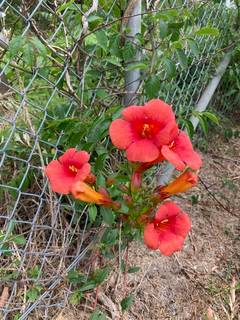
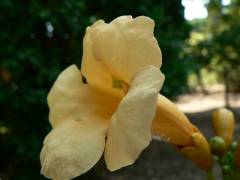
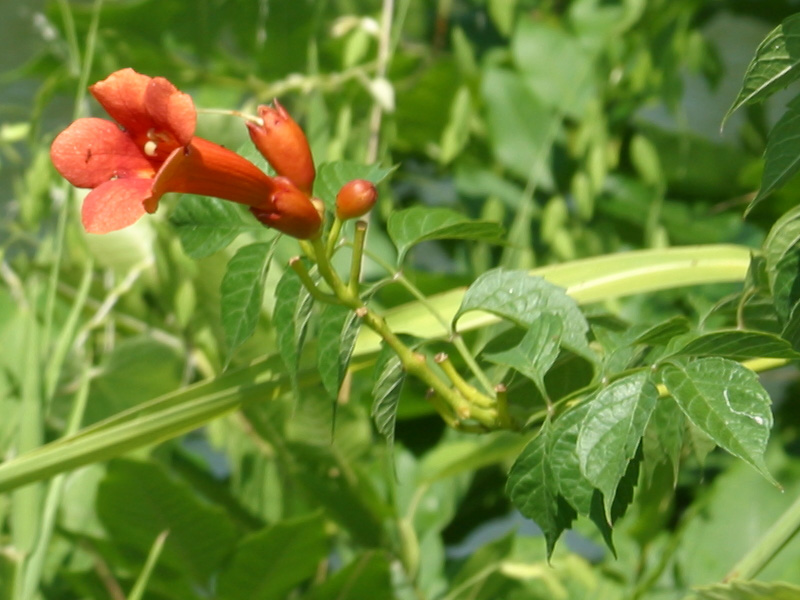
Campsis grandiflora is a deciduous woody climber reaching 20-30 feet (6-9 m) tall and 10-15 feet (3-4.5 m) across, ascending by twining stems and scattered aerial rootlets rather than the dense adhesive root pads of C. radicans. Its grip is weak enough that stems on tall walls pull away under their own weight unless tied to wires. Leaves are opposite and odd-pinnate with 7-9 coarsely toothed leaflets, each 1.2-2.5 inches (3-6.5 cm) long, mid-green and hairless on both surfaces and along the rachis. Flowers are borne in loose terminal panicles of 6-12 from July to September; each corolla is 2.5-3 inches (6-8 cm) long and about the same across the flared mouth, orange to scarlet outside with darker red veining inside the throat. The corolla tube is shorter and the mouth wider than in C. radicans, giving a shallow bowl rather than a narrow trumpet. Seed capsules 4-6 inches (10-15 cm) long ripen brown and split in autumn. Plants take 3-5 years from planting to first flowering, sucker from the root system at 3-10 feet (1-3 m) from the crown, and are hardy only to USDA zone 6, roughly two zones less cold-tolerant than C. radicans. Contact with the sap causes dermatitis in some people.
Native Range
Campsis grandiflora is native to eastern and central China, from Hebei and Shandong south to Guangdong and west to Sichuan, growing in scrub, on rocky slopes, and along woodland margins below 5,900 feet (1,800 m). It has been cultivated in China and Japan for centuries and is naturalized in Japan and Korea. In North America and Europe it persists around old plantings and along fencelines.Suggested Uses
Trained on pergolas, sturdy arbours, masonry walls with wire supports, and metal fences in USDA zones 6-9, where it screens 20-30 feet (6-9 m) of vertical surface within 5-8 seasons. Flowers are visited by hummingbirds in North American gardens and by bees and butterflies across its range. It is planted at a distance from timber structures, gutters, and mixed borders because of stem weight and root suckering.How to Identify
Appearance
Size & Dimensions
Height20' - 30'
Width/Spread10' - 15'
Bloom Information
Flowering runs from July to September in USDA zones 6-9, with a peak of 3-4 weeks in late July and August. Panicles open a few flowers at a time over 6-10 weeks, and each corolla lasts 2-3 days before dropping intact. Flowers form on the current season growth, so late spring frost damage to new shoots delays the display by 2-4 weeks. Seedlings and recently planted vines commonly produce no flowers for the first 3-5 years while the root system establishes.
Detailed Descriptions
Flower Description
Orange to scarlet with red throat veiningFoliage Description
Mid-greenGrowing Conditions
Sun Requirements
Requires 6-10 hours of direct sunlight daily
• Full Sun: 6+ hours of direct sunlight
• Partial Shade: 3-6 hours of direct sunlight
• Full Shade: Less than 3 hours of direct sunlight
Care & Maintenance
Care Guide
Flowering is heaviest with 6 or more hours of direct sun; in part shade the vine still climbs but produces panicles at a fraction of the density. Soil tolerance is wide across loam, clay, and sand at a pH of 5.5-7.5, with free drainage more important than fertility. Established plants tolerate drought and grow adequately on 1 inch (2.5 cm) of water every 10-14 days, while first-year plants need weekly irrigation through summer. High nitrogen fertilizer drives 6-10 feet (1.8-3 m) of stem growth per season with few flowers, so unfertilized soil generally produces more bloom. Root suckers appear 3-10 feet (1-3 m) from the crown and regrow from severed root fragments, which makes the vine difficult to remove from mixed borders once established. Mature stems can exceed 3 inches (7.5 cm) in diameter and their weight has been known to pull down gutters and lattice not rated for the load.Pruning
C. grandiflora flowers on the current season shoots, so hard cutting back in late winter or early spring, to a permanent framework of 2-4 main stems with spurs of 2-3 buds, produces the wood that flowers that summer. Unpruned vines build a tangle of old stems at the top of the support with flowering confined to the outer surface. Removing root suckers at ground level several times a season limits spread into surrounding beds. Summer pruning after mid-July cuts off developing panicles.Pruning Schedule
Prune: February–March
early spring