Campsis, Genus, spp., Multiple species,
- Genus
- Multiple species
trumpet vines
Overview
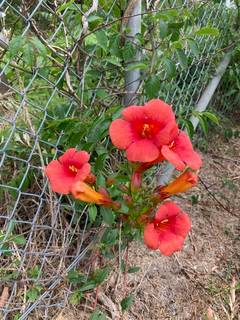
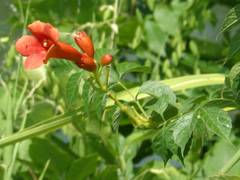
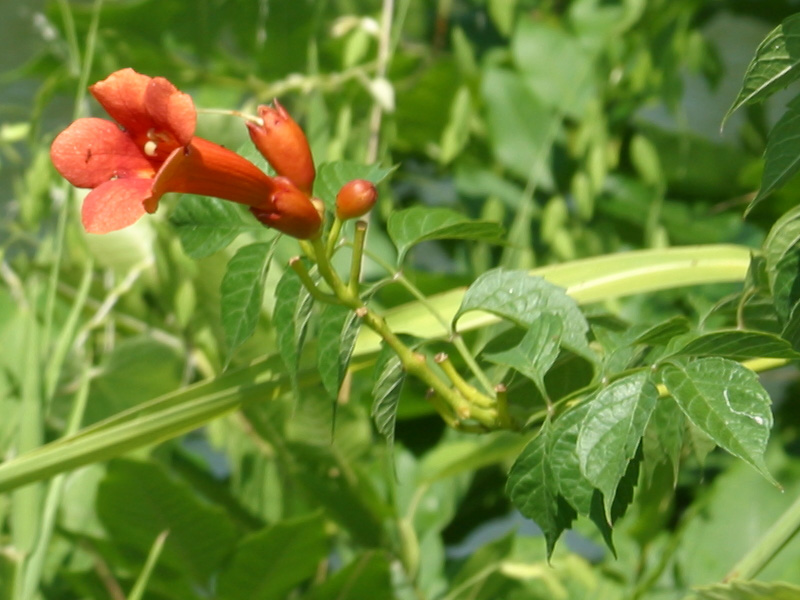
Campsis is a small genus of two deciduous woody climbers in the family Bignoniaceae, native to eastern North America (C. radicans) and East Asia (C. grandiflora), with the hybrid C. ×tagliabuana widely grown. The vines climb by twining stems and aerial rootlets to 25–40 ft (8–12 m), clinging to walls, trees, and structures, and they sucker freely from the roots to form thickets. Leaves are opposite and pinnately compound, 8–15 in (20–38 cm) long, with 7–11 toothed, lance-shaped leaflets that turn yellow before dropping in autumn. From midsummer into early autumn, terminal clusters of trumpet-shaped flowers 2–3.5 in (5–9 cm) long open in orange, red, and yellow, each flaring into five lobes. The flowers draw hummingbirds and large bees and are followed by bean-like seed capsules 4–8 in (10–20 cm) long that split to release winged seeds. Campsis grows in USDA zones 4–9 in full sun and tolerates poor soil, heat, and drought once established. The clinging rootlets can mark masonry, and the suckering roots and self-sown seedlings can spread well beyond the original planting.
Native Range
Campsis is native to two widely separated regions: C. radicans ranges across the southeastern and central United States in woodland edges, fencerows, and stream banks, while C. grandiflora comes from eastern China. Both have naturalised beyond their native ranges, and C. radicans grows as a roadside and old-field plant through much of eastern North America.Suggested Uses
Campsis is grown on pergolas, arbours, large fences, and masonry walls as a climber for summer flowers and hummingbird interest. The suckering habit suits bank stabilisation and screening on rough ground where its spread is acceptable. The vigour and root spread make it less suited to small gardens and confined sites near foundations.How to Identify
Appearance
Size & Dimensions
Height25' - 40'
Width/Spread6' - 12'
Bloom Information
Flowering runs from midsummer to early autumn, generally July to September, on the current season's growth. The trumpet flowers open in succession at the branch tips over several weeks. Bloom is heaviest in full sun and on established plants, drawing hummingbirds throughout the season.
Detailed Descriptions
Flower Description
orange, red, and yellowFoliage Description
greenGrowing Conditions
Sun Requirements
Requires 6-12 hours of direct sunlight daily
• Full Sun: 6+ hours of direct sunlight
• Partial Shade: 3-6 hours of direct sunlight
• Full Shade: Less than 3 hours of direct sunlight
Care & Maintenance
Care Guide
Campsis grows in full sun and almost any well-drained soil, tolerating heat, drought, and poor ground once established. A sturdy support such as a pergola, masonry wall, or stout fence is needed to carry the heavy, woody stems. Flowering is reduced in shade and on plants given rich soil or heavy nitrogen, which favour leafy growth over bloom. The vines sucker from the roots and self-seed, and stray shoots can appear several feet from the base. Hardiness reaches USDA zone 4 in C. radicans and about zone 6 in C. grandiflora. Propagation is by seed, cuttings, layering, or removal of rooted suckers.Pruning
Plants are pruned hard in late winter while dormant, cutting the previous year's growth back to a permanent framework of main stems. Because flowers form on new growth, this hard pruning does not reduce bloom and keeps the vine in bounds. Suckers and stray shoots are removed through the growing season to limit spread.Pruning Schedule
Prune: February–March
winter