Campanulastrum, Genus, spp., Multiple species,
- Genus
- Multiple species
American bellflower
Overview
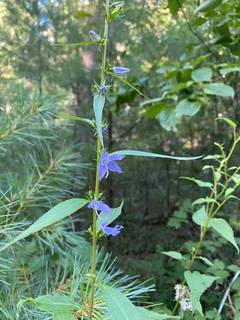
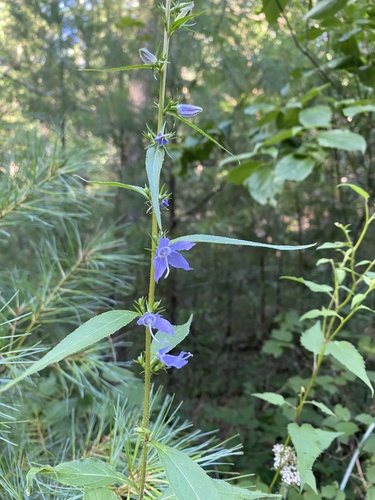
Campanulastrum is a genus in the bellflower family (Campanulaceae), represented in gardens by the American bellflower, Campanulastrum americanum, a herbaceous plant of eastern North American woodlands. Plants form an erect, largely unbranched stem 3-6 feet (90-180 cm) tall and 1-2 feet (30-60 cm) wide, completing growth as an annual or biennial. The alternate leaves are ovate to lance-shaped, 3-6 inches (8-15 cm) long, with toothed margins and a thin texture. Flowers open along the upper stem in a leafy spike, each one flat and star-shaped, 0.75-1 inch (2-2.5 cm) across, in blue to violet with a pale central ring and a long, downward-curving style. This flat corolla separates Campanulastrum from the bell-shaped flowers of related Campanula. Bloom runs through summer into early autumn, and plants set seed in small capsules that scatter nearby. Growth follows moist, humus-rich soil in partial shade at woodland edges, stream banks, and clearings, though stems in full sun stay shorter. Because the plant depends on self-sown seedlings, it shifts position within a planting from year to year rather than holding one spot, and dense stands can crowd smaller herbs.
Native Range
The single widely grown species, Campanulastrum americanum, is native to the eastern and central United States and adjacent Canada, from Ontario and New York south to Florida and west to the Great Plains. It grows in moist deciduous woods, ravines, and shaded streamsides.Suggested Uses
Plants are used in shaded native-plant and woodland gardens, along stream banks, and in naturalized borders where self-seeding is acceptable. The height places them toward the back of a planting, behind lower woodland perennials. The flowers support bees and other native pollinators.How to Identify
Appearance
Size & Dimensions
Height3' - 6'
Width/Spread1' - 2'
Bloom Information
Flowering runs from June to September, with each flower lasting a few days and opening in sequence up the stem. Across the genus the display concentrates in mid to late summer and extends into early autumn in cooler sites. Bees carry out most pollination before the capsules dry and split to release seed.
Detailed Descriptions
Flower Description
blue to violetFoliage Description
greenGrowing Conditions
Sun Requirements
Requires 3-6 hours of direct sunlight daily
• Full Sun: 6+ hours of direct sunlight
• Partial Shade: 3-6 hours of direct sunlight
• Full Shade: Less than 3 hours of direct sunlight