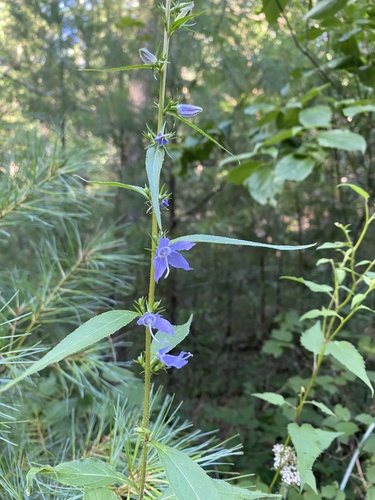
Campanulastrum, Genus, americanum, Species,
- Genus & species
tall bellflower
SunFull Sun – Part Shade
WaterMedium
Overview
Campanulastrum americanum, the tall or American bellflower, is an annual to short-lived biennial in the bellflower family native to eastern and central North America. It sends up a single, mostly unbranched stem 3-6 feet (90-180 cm) tall, lined with thin, toothed, lance-shaped leaves 3-6 inches (8-15 cm) long. Unlike the nodding bells of many Campanula, its flowers are flat and star-shaped, about 1 inch (2.5 cm) across, with five spreading blue to violet lobes and a pale ring at the center. A long, curved style arches out from each flower and then recurves at the tip. Flowers open a few at a time along the upper stem from summer into early autumn. It grows at the edges of moist woods, along streams, and in shaded clearings, often appearing after soil is disturbed. Plants set abundant seed and self-sow, returning year to year from seedlings rather than from a persistent root. Stems can grow lax and lean in rich shade and may need support in exposed sites.
Native Range
Native to eastern and central North America, from Ontario and New York west to Minnesota and South Dakota, and south to Florida and Arkansas. It grows along moist woodland edges, stream banks, ravines, and shaded roadsides, frequently on disturbed ground.Suggested Uses
Used in woodland gardens, shaded borders, and native and pollinator plantings where it can self-sow. Suited to the back of moist, partly shaded beds and to naturalized clearings under high trees.How to Identify
Appearance
Size & Dimensions
Height3' - 6'
Width/Spread1' - 2'
Bloom Information
Detailed Descriptions
Flower Description
blue to violetFoliage Description
greenGrowing Conditions
Sun Requirements
Requires 3-8 hours of direct sunlight daily
• Full Sun: 6+ hours of direct sunlight
• Partial Shade: 3-6 hours of direct sunlight
• Full Shade: Less than 3 hours of direct sunlight
Water & Climate
Water Needs
Care & Maintenance
Care Guide
Grows in partial shade to morning sun on moist, fertile, well-drained soils, and tolerates full sun where the soil stays damp. It grows most strongly with steady moisture and can wilt in dry shade. Because it is annual or biennial, it relies on self-sown seedlings to persist, so leaving some seed heads in place maintains a stand. Sow seed in fall or press it onto the surface in early spring, as light aids germination. It has few serious pests, though slugs may damage seedlings. Tall stems in rich soil can flop and may need staking.Pruning
No routine pruning is needed. Spent stems can be cut after flowering, though leaving some to set seed ensures plants return the next year. Taller stems may be staked or cut back early to reduce flopping.Toxicity
Non-toxicPlanting Guide
Planting Methods & Timing
Planting Method
direct sow
Direct Sow Timing
fall or early spring
Plant Spacing
12 inches