Bougainvillea, Genus, glabra, Species,
- Genus & species
Bougainvillea
Overview
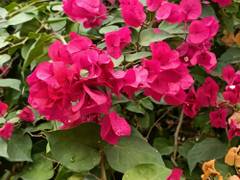
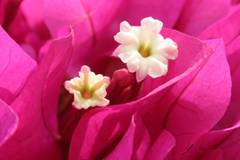
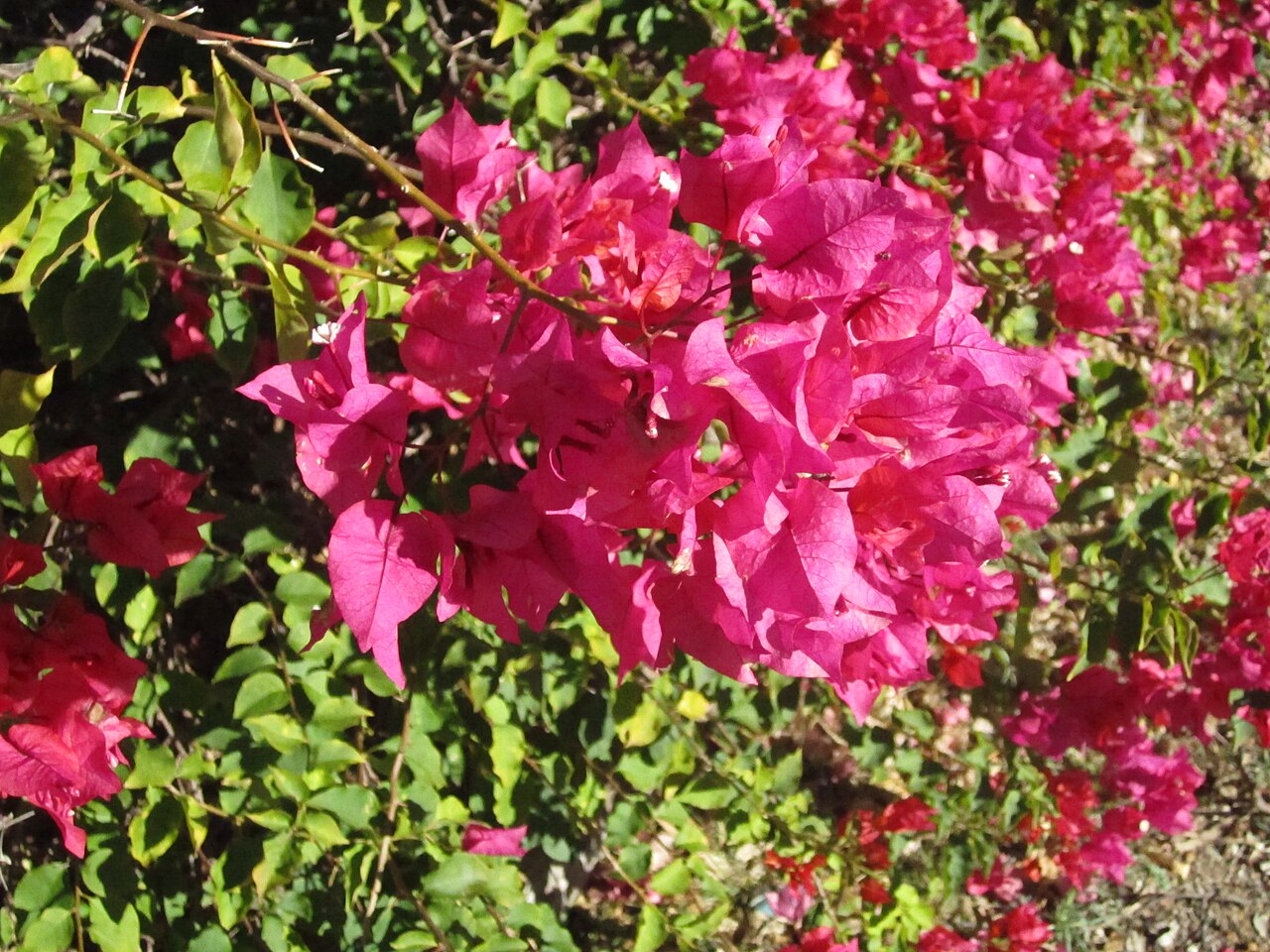
Bougainvillea glabra is an evergreen woody climber reaching 15-30 feet (4.5-9 m) on a support and 10-20 feet (3-6 m) across, held to 3-6 feet (90-180 cm) as a shrub under regular cutting. Stems are arching and woody, and each leaf axil carries a straight spine 0.25-0.75 inch (6-19 mm) long that hooks the plant into surrounding growth. Leaves are alternate, ovate to elliptic, 2-4 inches (5-10 cm) long, mid-green and hairless on both surfaces. The coloured display comes from papery bracts 1-1.5 inches (2.5-4 cm) long in magenta, purple, pink, or white, borne in threes around three small cream tubular flowers 0.5-0.75 inch (13-19 mm) long. Bracts hold six to eight weeks per flush, and a plant in a warm climate carries three or four flushes a year on new growth. Bract production falls away in shade and under high nitrogen or steady watering, both of which push leafy shoots instead. Roots are brittle and poorly branched, so plants moved with a disturbed root ball stall for a season or die outright. Top growth is killed near 27 F (-3 C). Hardy in USDA zones 9b-11.
Native Range
Bougainvillea glabra is native to Brazil, in Mato Grosso do Sul and the eastern coastal region, where it scrambles through dry forest margins and gallery woodland. It has naturalised across the tropics and subtropics, including parts of Australia, southern Africa, India, and the Mediterranean basin. Several of those regions record it as an environmental weed spreading from dumped garden waste and layered stems.Suggested Uses
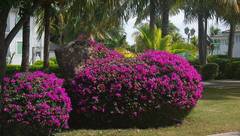
Grown on pergolas, wire-supported walls, fences, and archways in zones 9b-11, and trained as a standard or clipped shrub at 3-6 feet (90-180 cm) in smaller courtyards. Container culture in pots of 10 gallons (38 L) or larger allows the plant to be wintered under glass in colder zones. The axillary spines suit it to barrier planting along boundaries, spaced 6-10 feet (1.8-3 m) apart.How to Identify
Appearance
Size & Dimensions
Height15' - 30'
Width/Spread10' - 20'
Bloom Information
In frost-free climates bract production runs in three or four flushes between March and November, each lasting six to eight weeks with two to four weeks of leafy growth between. Bracts form on wood produced in the current season, so every flush follows a cycle of new shoot extension. Flushes intensify where watering is reduced for two to three weeks as the shoots harden, and continuous irrigation holds the plant in leaf. The small cream flowers inside the bracts carry nectar taken by butterflies and hawkmoths.
Detailed Descriptions
Flower Description
Cream tubular flowers surrounded by magenta, purple, pink, or white papery bractsFoliage Description
Mid-green, hairless on both surfacesGrowing Conditions
Sun Requirements
Requires 6-12 hours of direct sunlight daily
• Full Sun: 6+ hours of direct sunlight
• Partial Shade: 3-6 hours of direct sunlight
• Full Shade: Less than 3 hours of direct sunlight
Care & Maintenance
Care Guide
Six or more hours of direct sun carries full bract colour; at three to four hours the plant grows strongly and colours poorly. The species grows in free-draining sandy or loamy soil at pH 5.5-6.5, tolerates infertile ground and coastal salt spray, and fails in soil that stays wet. Established plants run three to four weeks without water, and a cycle of deep watering every two to three weeks in summer followed by a dry interval drives the flushes. A low-nitrogen fertiliser with higher potassium applied at the start of each growth cycle supports bract formation, while high-nitrogen feeds produce leaf at the expense of colour. Plants are set out with the root ball intact and the container cut away rather than the plant pulled from it, because the brittle root system does not recover from disturbance. In zones 8-9a the plant is grown in a container of 10 gallons (38 L) or larger and moved under cover below 32 F (0 C).Pruning
Stems are cut back by one-third immediately after each flush of bracts fades, which triggers the new growth carrying the next flush. Hard renewal cutting to a framework of three to five main stems is done in late winter before growth restarts, taking out crossed and inward-facing wood. Long whips are tied horizontally rather than shortened, since bracts form on laterals that break from horizontal wood. Cutting during a flush removes the coloured bracts along with the growing points.Pruning Schedule
Prune: February–March, June & September
early springsummerfall
Container Growing
Suitable for container growing
Minimum container size: 10 gallons