Bougainvillea, Genus, spp., Multiple species,
- Genus
- Multiple species
bougainvilleas
Overview
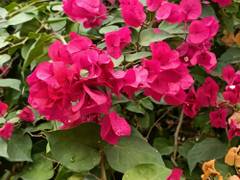
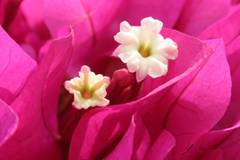
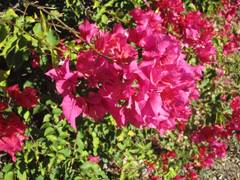
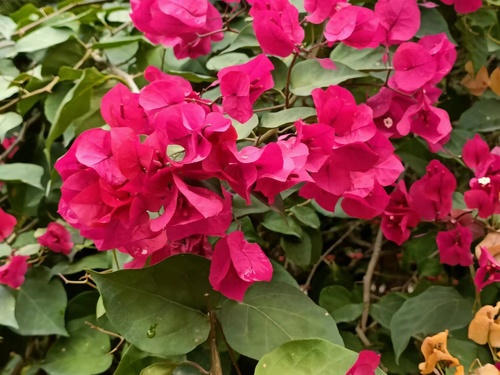
Bougainvillea is a genus of about 4 to 18 species of thorny, woody vines, shrubs, and small trees in the family Nyctaginaceae, native to South America. Stems are armed with sharp axillary thorns 0.2-0.8 inch (5-20 mm) long and climb 3-40 feet (1-12 m) where support exists, or form mounded shrubs 3-10 feet (0.9-3 m) tall without it. The true flowers are small, tubular, white to cream, 0.4-0.8 inch (10-20 mm) long, and grouped in threes. Each flower is backed by a papery bract; the bracts carry the color and span magenta, purple, red, orange, pink, white, and yellow across the genus, each measuring 1-2 inches (2.5-5 cm). Leaves are alternate, ovate, 1.5-4 inches (4-10 cm) long, and mid-green, remaining on the plant in frost-free climates though shed during drought or cold. Flowering comes in repeated flushes through the warm months, heaviest where soil moisture is restricted. Bougainvillea grows in USDA zones 9-11 and is damaged below 30F (-1C). The genus tolerates heat, salt spray, and poor soils, but it does not survive hard frost, and the thorns make stem handling slow.
Native Range
Native to South America, with the greatest concentration of species in Brazil and additional species in Peru, Argentina, and neighboring tropical and subtropical regions. It is now widely naturalized and cultivated in warm climates worldwide.Suggested Uses
Grown on walls, fences, pergolas, and trellises as a climbing vine, and trained as a freestanding shrub, hedge, or container specimen. In frost-free regions it is used as ground cover on slopes and as bonsai. The thorns limit placement near walkways and seating.How to Identify
Appearance
Size & Dimensions
Height3' - 40'
Width/Spread3' - 30'
Colors
Bloom Information
Blooms in repeated flushes during the warm months, typically spring through fall in subtropical climates and nearly year-round in frost-free tropical settings. Flowering intensifies when soil moisture is reduced and light is high. Each bract display persists 4-6 weeks before fading.
Detailed Descriptions
Flower Description
white to cream flowers with magenta, purple, red, orange, pink, white, or yellow bractsFoliage Description
mid-greenGrowing Conditions
Sun Requirements
Requires 6-10 hours of direct sunlight daily
• Full Sun: 6+ hours of direct sunlight
• Partial Shade: 3-6 hours of direct sunlight
• Full Shade: Less than 3 hours of direct sunlight
Care & Maintenance
Care Guide
Grows in full sun with at least 5-6 hours of direct light and produces few bracts in shade. Well-drained soil is required; established plants tolerate drought, while consistently wet roots cause root rot. Deep, infrequent watering with the soil drying between cycles encourages bract formation, whereas constant moisture pushes leafy growth. Low-nitrogen fertilizer during the growing season supports flowering, since high nitrogen favors foliage over bracts. Most species grow in USDA zones 9-11 and sustain damage below 30F (-1C), and container specimens can be moved under cover in cooler regions. B. spectabilis, B. glabra, and their hybrids account for most cultivated forms.Pruning
Pruning after a flowering flush shapes the plant and controls size; flowers form at the tips of long, whippy stems, so cutting these stems removes upcoming bracts. Hard pruning in late winter or early spring clears old growth before the new season. The axillary thorns slow the work.Pruning Schedule
Prune: February–March
winterearly spring
Container Growing
Suitable for container growing
Minimum container size: 5 gallons