Avicennia, Genus, marina, Species,
- Genus & species
grey mangrove
Indo-Pacific, Australia, Asia, eastern Africa
Overview
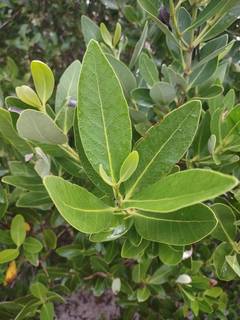
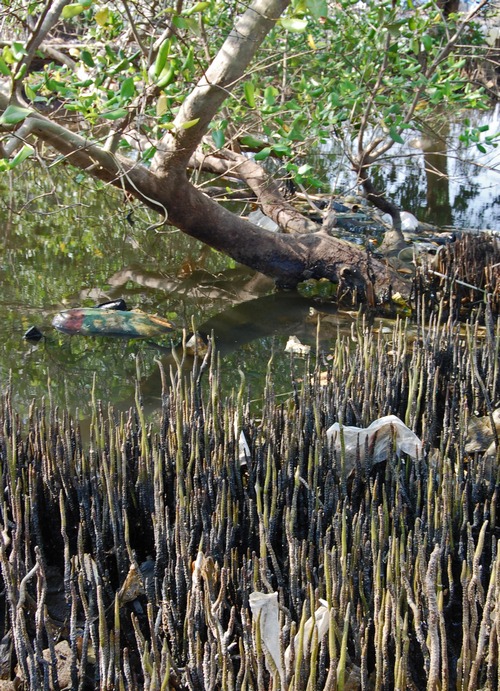
Avicennia marina is a salt-tolerant mangrove tree or shrub in the family Acanthaceae, reaching 10-33 feet (3-10 m) tall, and lower and shrubbier in colder or more exposed sites. The smooth bark is pale grey, and the leaves are oval, 1.5-3 inches (4-8 cm) long, grey-green above and silvery or whitish beneath, where salt-excreting glands shed excess salt. The plant produces forests of pencil-like aerial roots, called pneumatophores, that rise from the mud around the trunk and supply oxygen to the roots in waterlogged, oxygen-poor sediment. Small orange to yellow flowers about 0.2-0.3 inch (5-8 mm) across appear in summer, followed by flattened grey-green fruit that germinate on or soon after release, a form of vivipary. It grows along sheltered tropical and temperate coastlines, in estuaries, tidal flats, and saltmarsh, across northern and eastern Australia and through the Indo-Pacific, Asia, and eastern Africa. Among mangroves it extends into cooler latitudes, reaching farther south than other species. The plant depends on tidal saltwater and cannot grow as a conventional garden plant. It is slow to establish and is damaged by oil pollution and altered tidal flow.
Native Range
Avicennia marina is native to coastlines across northern and eastern Australia and widely through the Indo-Pacific, southern and eastern Asia, the Middle East, and eastern Africa. It grows in estuaries, tidal mudflats, and saltmarsh within the intertidal zone.Suggested Uses
Used in coastal restoration, estuary rehabilitation, and shoreline stabilisation, where the roots trap sediment and reduce erosion. The stands provide nursery habitat for fish, crabs, and shorebirds. It features in botanic and educational collections rather than as a garden ornamental.How to Identify
Appearance
Size & Dimensions
Height10' - 33'
Width/Spread10' - 20'
Bloom Information
Small orange to yellow flowers open in summer, roughly December to March in the native range. Flowering is followed by flattened grey-green fruit that germinate on or shortly after release. The flowers are visited by bees and yield a pale honey.
Detailed Descriptions
Flower Description
orange to yellowFoliage Description
grey-greenGrowing Conditions
Sun Requirements
Requires 6-12 hours of direct sunlight daily
• Full Sun: 6+ hours of direct sunlight
• Partial Shade: 3-6 hours of direct sunlight
• Full Shade: Less than 3 hours of direct sunlight