Avicennia, Genus, spp., Multiple species,
- Genus
- Multiple species
black mangrove
Tropical and subtropical coasts worldwide
Overview
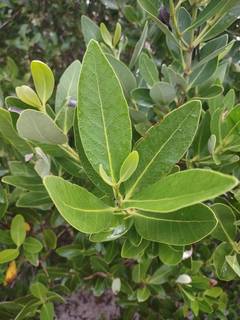
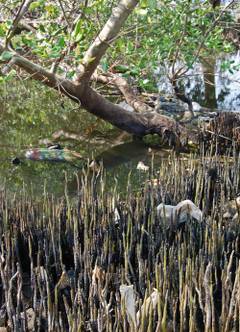
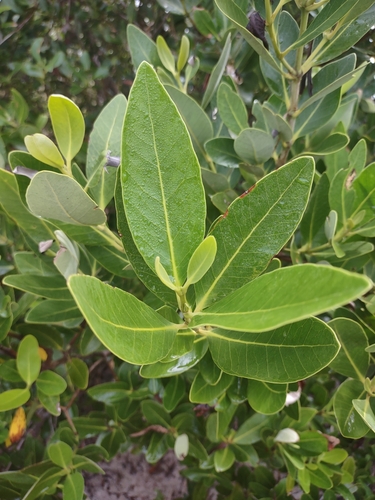
Avicennia is a genus of evergreen mangrove trees and shrubs in the family Acanthaceae, comprising about eight species of tropical and subtropical tidal coastlines. Plants range from low shrubs 3-10 feet (1-3 m) tall at range limits to trees 30-50 feet (9-15 m) in equatorial estuaries. Leaves are opposite, leathery, elliptic, 1.5-4 inches (4-10 cm) long, green above and pale or grey beneath, and excrete salt through glands that often leave a white crust. Roots produce upright, pencil-like pneumatophores that project 4-12 inches (10-30 cm) above the mud for gas exchange in waterlogged soil. Small flowers, 0.2-0.4 inch (5-10 mm) across, are yellow to orange and clustered at the branch tips. The fruit is a flattened, grey-green capsule about 0.8-1.5 inches (2-4 cm) long that germinates while still on the tree or shortly after dropping. Plants are evergreen and tolerate full-strength seawater, but are killed by hard frost. Growth is slow to moderate in the saline, oxygen-poor substrate.
Native Range
The genus occurs on tropical and subtropical coasts worldwide, including the Americas, Africa, southern and eastern Asia, and Australasia, with A. marina the widest-ranging species. Plants grow in the intertidal zone of estuaries, lagoons, and sheltered shores, rooted in saline mud between mean sea level and high-tide level.Suggested Uses
Planted in mangrove restoration and shoreline stabilization projects along tropical and subtropical estuaries, spaced 3-6 feet (1-2 m) apart. Stands form nursery habitat for fish and crustaceans and buffer coasts against storm surge. The genus is rarely used as an ornamental and needs tidal saltwater conditions to persist.How to Identify
Appearance
Size & Dimensions
Height3' - 50'
Width/Spread5' - 20'
Bloom Information
Flowering occurs mainly in the warm season, from late spring through summer in subtropical regions and over a longer span near the equator. Flowers open over several weeks and are visited heavily by bees. Capsules develop through summer and autumn and may germinate on the branch.
Detailed Descriptions
Flower Description
yellow to orangeFoliage Description
green above, grey beneathGrowing Conditions
Sun Requirements
Requires 6-12 hours of direct sunlight daily
• Full Sun: 6+ hours of direct sunlight
• Partial Shade: 3-6 hours of direct sunlight
• Full Shade: Less than 3 hours of direct sunlight