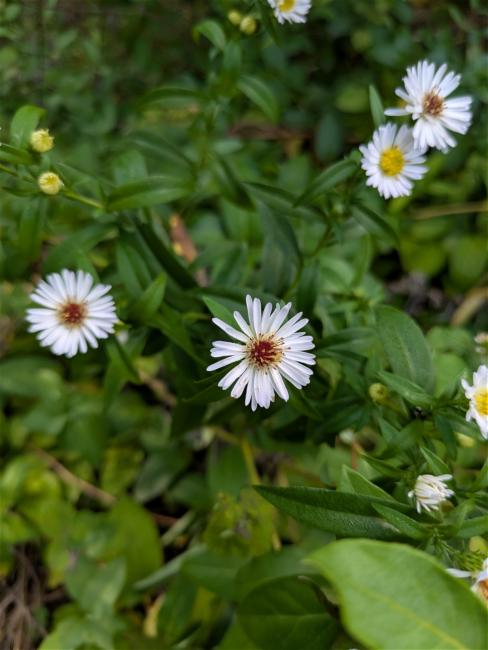
Aster novi-belgii
new york aster
Eastern North America, primarily coastal areas from Newfoundland south to Georgia
Overview
Aster novi-belgii (synonym Symphyotrichum novi-belgii) is a native North American aster in the Asteraceae spp. family that grows 24–48 inches (60–120 cm) tall and 18–36 inches (45–90 cm) wide. Dense clusters of flower heads 1–1.5 inches (2.5–4 cm) across with violet-blue ray florets and yellow disc centres open from August through October. Smooth, lance-shaped medium green leaves clasp the stems without petioles — the smooth leaf surface separates this species from the hairy-stemmed A. novae-angliae. The plant spreads by vigorous stoloniferous rhizomes, forming expanding colonies that can cover large areas in moist soil. The aggressive spread requires regular division or containment in garden settings. Powdery mildew is the main maintenance concern; the species shows high susceptibility, with lower and mid-stem foliage developing heavy white coating by late summer in humid climates. Good air circulation, full sun, and watering at the base rather than overhead reduce mildew severity. Unlike A. novae-angliae, the flowers of A. novi-belgii stay open at night and on cloudy days. Lower leaves typically brown and drop by bloom time. The species has been extensively hybridised in Europe, producing hundreds of named cultivars from 10 inches (25 cm) to 48 inches (120 cm) tall in colours from white through pink, purple, and blue. Deer bypass the foliage.
Native Range
Aster novi-belgii is native to eastern North America, primarily along the Atlantic coast from Newfoundland south to Georgia. It occurs naturally in moist meadows, salt marsh edges, and coastal wetlands, with some inland populations along stream margins.Suggested Uses
Used in fall perennial borders, cottage gardens, and naturalistic plantings. The species is the parent of most European Michaelmas daisy hybrids. Suited to moist meadow plantings and pond-edge sites where the aggressive rhizome spread can fill large naturalised areas. An important late-season pollinator resource.How to Identify
Appearance
Size & Dimensions
Height2' - 4'
Width/Spread1'6" - 3'
Reaches mature size in approximately 2 years
Bloom Information
Flowering begins in late August and continues through October. Dense clusters of violet-blue flower heads open in succession over approximately 6 weeks. Unlike A. novae-angliae, flowers stay open at night and in overcast weather. Seed heads develop after petal drop and persist through winter.
Detailed Descriptions
Flower Description
Violet-blue with yellow disc centresFoliage Description
Medium green, lance-shaped, smooth, claspingGrowing Conditions
Sun Requirements
Requires 6-10 hours of direct sunlight daily
• Full Sun: 6+ hours of direct sunlight
• Partial Shade: 3-6 hours of direct sunlight
• Full Shade: Less than 3 hours of direct sunlight
Care & Maintenance
Care Guide
Site in full sun with at least 6 hours of direct light. Average to moist soil; tolerates clay. Space plants 18–24 inches (45–60 cm) apart with good air circulation to reduce powdery mildew incidence. Pinch stem tips by one-third in early June to promote compact, branching growth. Divide clumps every 2–3 years in spring to control rhizome spread and maintain vigour. Water at the base rather than overhead to keep foliage dry. Cut all stems to ground level in late fall or early spring.Pruning
Pinch stem tips by one-third in early June for more compact growth. Cut all stems to 3–4 inches (8–10 cm) above ground in late fall or early spring. Divide aggressive clumps every 2–3 years.Pruning Schedule
J
F
M
A
M
J
J
A
S
O
N
D
summerfallearly spring