Image 1 of 10
Plant Reference
1 / 10
Asplenium, Genus, nidus, Species,
- Genus & species
Bird's nest fern
Tropical and subtropical regions worldwide (the broader native range covers tropical and subtropical East Asia, Southeast Asia, Australia, the Pacific Islands, and parts of tropical East Africa); humid tropical-rainforest canopy positions where the species grow as epiphytes attached to tree trunks and branches at the canopy and sub-canopy levels with bright filtered light, high atmospheric humidity, and consistent year-round warm temperatures.
Overview
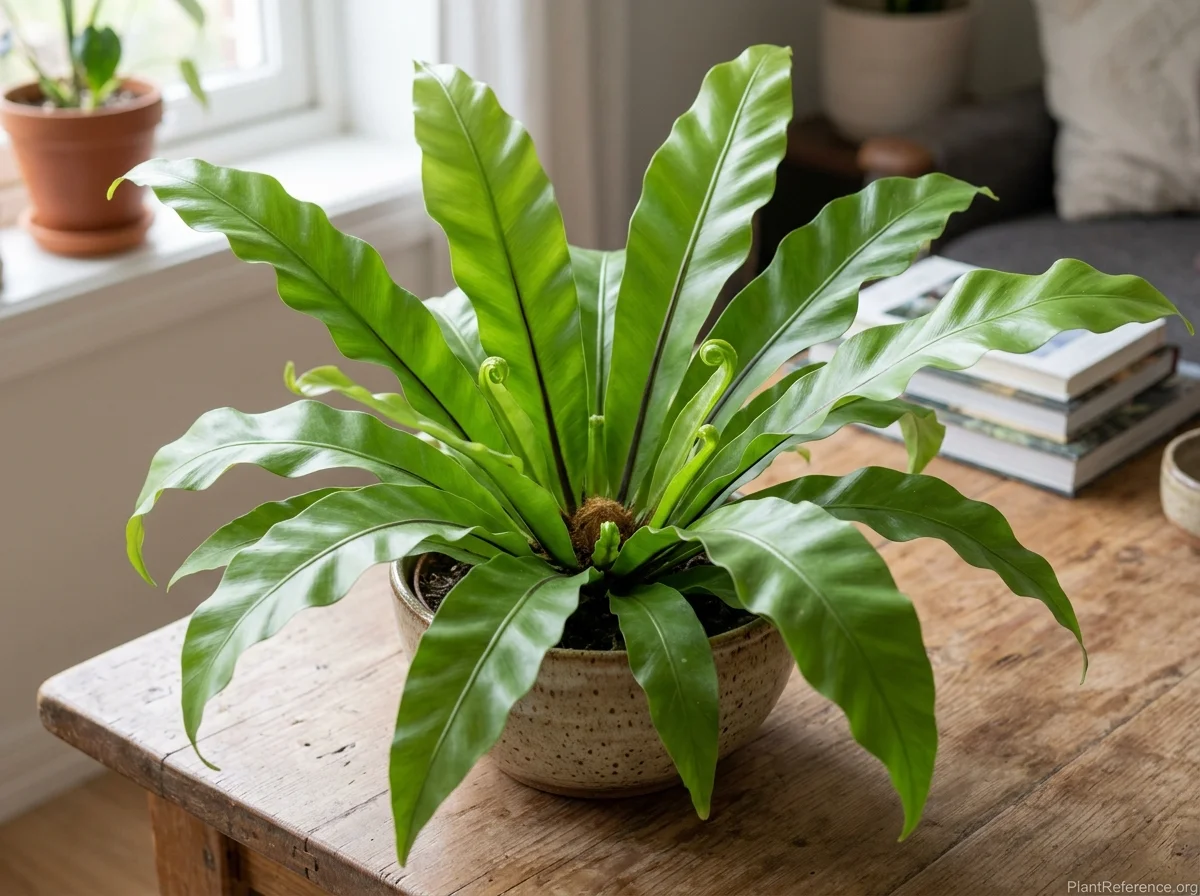
Asplenium nidus is the bird's nest fern (also called nest fern), an evergreen epiphytic fern in the spleenwort family (Aspleniaceae) growing 18-36 inches (45-90 cm) tall and wide as an indoor houseplant or in protected outdoor cultivation in tropical zones 10-12. The species' common name and the species' specific epithet 'nidus' (Latin for 'nest') both reference the species' principal physical feature: the wide undivided glossy strap-shaped fronds 12-30 inches long and 2-6 inches wide are arranged radiating outward from a central rosette in a vase-or-shuttlecock form, and the central rosette is a fuzzy brown structure that resembles a small bird's nest. In the species' tropical-rainforest native habitat, debris and small organisms accumulate within the central rosette over time, and the rosette functions as a working nest-like microhabitat for canopy-dwelling animals — the visual resemblance and the functional resemblance of the rosette to a small nest both contributed to the species' common name. The species' principal cultivation distinction is the wide undivided strap-shaped frond architecture, which is structurally distinct from the lacy or feathery divided-frond architecture of most other commonly cultivated indoor ferns (Adiantum maidenhair fern, Nephrolepis Boston fern, Pteris brake fern, Polystichum holly fern) and supplies the species an indoor design role beyond the standard fern aesthetic — the broad simple frond form pairs more readily with modern minimalist indoor design vocabularies than the lacy traditional-fern architecture does, and the species accordingly is among the more design-forward indoor ferns in contemporary planting compositions. The species is epiphytic in the wild native range — the species attach to tree trunks and branches in tropical-rainforest canopy positions rather than rooting in forest-floor soil — and the species' physiological adaptations reflect the epiphytic native habitat: the central rosette captures fallen leaf litter and organic debris that decomposes slowly to supply nutrients to the species' shallow root system, and the wide upturned frond form channels water and debris toward the central rosette rather than allowing both to fall through to the forest floor below. Indoor cultivation accordingly attends to two cultivation principles that distinguish the species from soil-grown houseplants: water is applied to the substrate around the rosette base rather than poured directly into the central rosette (water pouring into the rosette can produce rot of the central growing tissue and developing fronds), and the developing fronds emerging from the central rosette are not handled or disturbed because the unfurling fronds are tender and easily damaged by handling. The species tolerates lower indoor light conditions than most other commonly cultivated indoor ferns and can be grown in north-facing rooms, interior offices, and other low-light positions where the lacy traditional-fern species would not survive. The species is more tolerant of the dry-air indoor environments that most homes provide than the demanding Adiantum maidenhair fern is, although consistent humidity (40%+ relative humidity) supports better growth than dry-air positions do. The species is non-toxic to humans and pets and is suitable for households with cats, dogs, or small children where ornamental-plant toxicity is a concern. Hardy outdoors only in tropical zones 10-12; in cold-climate zones the species is grown exclusively as an indoor houseplant in 3-gallon (11-liter) or larger pots.
Native Range
Asplenium nidus is native to tropical and subtropical regions worldwide with a continuous native range covering tropical and subtropical East Asia (southern China, Taiwan, southern Japan), Southeast Asia (Thailand, Vietnam, Malaysia, Indonesia, the Philippines), the Indian subcontinent, Australia (Queensland and northern New South Wales), the Pacific Islands (Fiji, Samoa, Hawaii where the species was introduced and has naturalized), and parts of tropical East Africa (Madagascar and the East African mainland). The species occurs as an epiphyte in humid tropical-rainforest canopy positions where the plants attach to tree trunks and branches at the canopy and sub-canopy levels with bright filtered light, high atmospheric humidity, consistent year-round warm temperatures (typically 65-85°F / 18-29°C), and consistent rainfall patterns from tropical-monsoon climate cycles. The species has been introduced into ornamental cultivation broadly across temperate and tropical regions worldwide and is grown indoors as a sculptural foliage houseplant in cold-climate zones across the temperate Northern Hemisphere and outdoors in tropical zone-10-12 gardens.Suggested Uses
Used as a sculptural foliage houseplant in residential and commercial indoor settings, in modern minimalist interior design compositions where the wide undivided strap-shaped frond architecture pairs with contemporary design vocabularies, and in bathroom or kitchen indoor positions where the elevated humidity supports optimal performance. The species is among the more design-forward indoor ferns in contemporary planting compositions because the broad simple frond form pairs more readily with modern minimalist design than the lacy traditional-fern architecture does. The species is non-toxic to humans and pets and is suitable for households with cats, dogs, or small children where ornamental-plant toxicity is a concern. The species pairs with companion low-light tropical houseplants including Calathea cultivars, Maranta cultivars, Philodendron cultivars, Pothos (Epipremnum aureum), and Spathiphyllum (peace lily) for a multi-species indoor foliage planting where the Asplenium sculptural rosette of wide fronds contributes a textural and architectural contrast against the broader-leafed and trailing companion foliage. Outdoor cultivation in tropical zones 10-12 in protected partial-shade positions in shade gardens and tropical-foliage compositions extends the species' design role beyond indoor houseplant use.How to Identify
Appearance
Size & Dimensions
Height1'6" - 3'
Width/Spread1'6" - 3'
Colors
Foliage Colors
Fall Foliage Colors
Bloom Information
Ferns do not produce flowers because ferns are non-flowering vascular plants in the broader pteridophyte plant lineage that reproduces through spores rather than flowers. The species produces small linear sori (clusters of spore-producing sporangia) arranged in lines along the frond underside parallel to the central midrib in mature fronds and visible as raised brown lines on the underside of fully-mature fronds — the sori are the species' reproductive organs in the absence of flowers. Indoor specimens commonly produce sori on mature fronds across the active growing season, and the brown sori lines on the frond undersides are not a sign of disease or pest damage as new gardeners sometimes assume but are simply the species' normal reproductive structures.
Detailed Descriptions
Foliage Description
Bright apple-green; wide undivided glossy strap-shaped fronds 12-30 inches (30-75 cm) long and 2-6 inches (5-15 cm) wide arranged radiating outward from a central rosette in a vase or shuttlecock form, with each frond carrying a prominent central midrib (rachis) along the length and a slightly wavy or undulating margin in mature fronds; the strap-shaped undivided frond architecture distinguishes the species from the lacy or feathery divided-frond architecture of most other commonly cultivated indoor ferns (Adiantum maidenhair fern, Nephrolepis Boston fern, Pteris brake fern) and supplies the species' principal foliage signature in indoor cultivationGrowing Conditions
Sun Requirements
Requires 2-4 hours of direct sunlight daily
• Full Sun: 6+ hours of direct sunlight
• Partial Shade: 3-6 hours of direct sunlight
• Full Shade: Less than 3 hours of direct sunlight
Care & Maintenance
Care Guide
Place in low to moderate indirect light — the species tolerates lower indoor light conditions than most other commonly cultivated indoor ferns and can be grown in north-facing rooms, interior offices, and other low-light positions where the lacy traditional-fern species would not survive. Direct afternoon sun in indoor settings produces foliage scorch and the species is sited away from intense direct-sun positions. Water by applying water to the substrate around the rosette base rather than pouring directly into the central rosette — water pouring into the central rosette can produce rot of the central growing tissue and developing fronds, and the species' shallow root system absorbs water from the substrate without difficulty. Maintain the substrate evenly moist across the active growing season — the species tolerates brief dry periods but performs better with consistent moisture, and prolonged drought produces frond browning and tip necrosis. Moderate to high ambient humidity (40-60%+ relative humidity) supports better growth than dry-air positions do, although the species is more tolerant of dry indoor air than the demanding Adiantum maidenhair fern is. Substrate is well-draining slightly-acidic potting mix with added organic matter (sphagnum peat, finely-shredded bark, or coco coir) to retain moisture; pH 5.0-6.5 supports the species reliably. Fertilization is at quarter to half-strength every 2-3 months during the active growing season (spring through summer) using a balanced liquid fertilizer; over-fertilization produces frond burn and is therefore avoided. The developing fronds emerging from the central rosette are not handled or disturbed because the unfurling fiddleheads are tender and easily damaged. Hardy outdoors only in tropical zones 10-12; in cold-climate zones the species is grown exclusively as an indoor houseplant in 3-gallon (11-liter) or larger pots. The species is non-toxic to humans and pets.Pruning
Remove dead or browned outer fronds at the base of the frond rosette by cutting near the rosette attachment point. Live green fronds are not removed because each living frond contributes to the plant's photosynthetic capacity and premature removal of green fronds reduces plant vigor. The central rosette and the developing fronds emerging from it are not handled or disturbed because the unfurling fiddleheads are tender and easily damaged by physical contact. The species does not benefit from active pruning for shape or growth control because the natural radiating-frond rosette form supplies the species' principal ornamental character without pruning intervention.Container Growing
Suitable for container growing
Minimum container size: 3 gallons