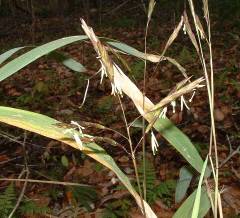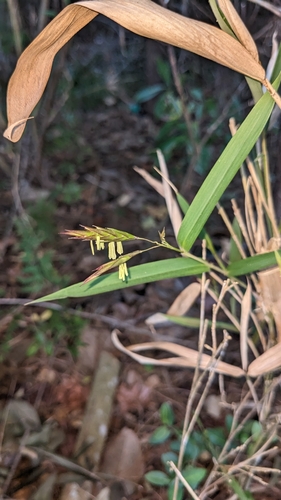
Arundinaria, Genus, tecta, Species,
- Genus & species
switch cane
Overview
Arundinaria tecta is a running, woody-stemmed bamboo in the grass family, native to the southeastern United States, growing 2-8 feet (0.6-2.4 m) tall on slender, hollow, jointed canes. It spreads aggressively by underground rhizomes to form dense colonies known as canebrakes. The evergreen leaves are narrow, flat blades 4-8 inches (10-20 cm) long, borne on leafy side branches near the top of the canes. New canes emerge in spring topped with papery sheaths. It is one of three bamboos native to North America and is smaller than giant cane, A. gigantea. Flowering is rare and irregular, with a colony sometimes blooming all at once and then dying back. The species grows in wet pine savannas, bogs, swamp margins, and along streams on the coastal plain, tolerating standing water and seasonal flooding. Its running rhizomes let it spread well beyond where it is planted, which can make it hard to contain in gardens. Historically, canebrakes of this species covered large areas of the southeast and gave cover to wildlife. It tolerates sun to part shade and grows on moist, acidic soils. Hardy in USDA zones 6 to 9.
Native Range
Native to the coastal plain of the southeastern United States, from Maryland and Virginia south to Florida and west to Texas, growing in wet pine savannas, bogs, swamp edges, bottomlands, and along streams.Suggested Uses
Used for erosion control, streambank stabilization, rain gardens, and wildlife plantings in wet ground, where its spreading habit binds soil. It forms a tall evergreen screen or naturalized thicket in damp areas. Suited to large or boggy sites because of its running rhizomes, where spread is not a concern.How to Identify
Appearance
Size & Dimensions
Height2' - 8'
Width/Spread3' - 6'
Bloom Information
Flowering is rare and unpredictable, occurring at long, irregular intervals rather than every year. When a colony flowers, it produces grass-like spikelets and often dies back afterward. Most stands spread by rhizomes and may go decades without blooming.
Detailed Descriptions
Foliage Description
greenGrowing Conditions
Sun Requirements
Requires 4-8 hours of direct sunlight daily
• Full Sun: 6+ hours of direct sunlight
• Partial Shade: 3-6 hours of direct sunlight
• Full Shade: Less than 3 hours of direct sunlight
Care & Maintenance
Care Guide
Grow in full sun to part shade in moist to wet, acidic soil; the species tolerates poor drainage and seasonal flooding. It spreads quickly by rhizomes, so a root barrier or a naturally confined wet site keeps it in bounds. Water is needed in dry spells, as the plant is adapted to damp ground. It establishes most readily where soil stays consistently moist. Cutting canes to the ground in late winter renews the stand. Few pests or diseases trouble it.Pruning
Cut out old, dead, or damaged canes at ground level in late winter to keep the colony fresh. Mowing or cutting back the whole stand renews growth and controls height. Rhizome spread is limited by edging or by cutting runners at the colony margin.Pruning Schedule
Prune: February–March
winterearly spring
Container Growing
Suitable for container growing
Minimum container size: 7 gallons