Image 1 of 6
1 / 6
© Ghislain118 http://www.fleurs-des-montagnes.net, some rights reserved (CC-BY-SA) · Wikimedia Commons
Aruncus, Genus, dioicus, Species, var., Variety, aethusifolius, Variety,
- Genus & species
- Variety
dwarf goatsbeard
Overview
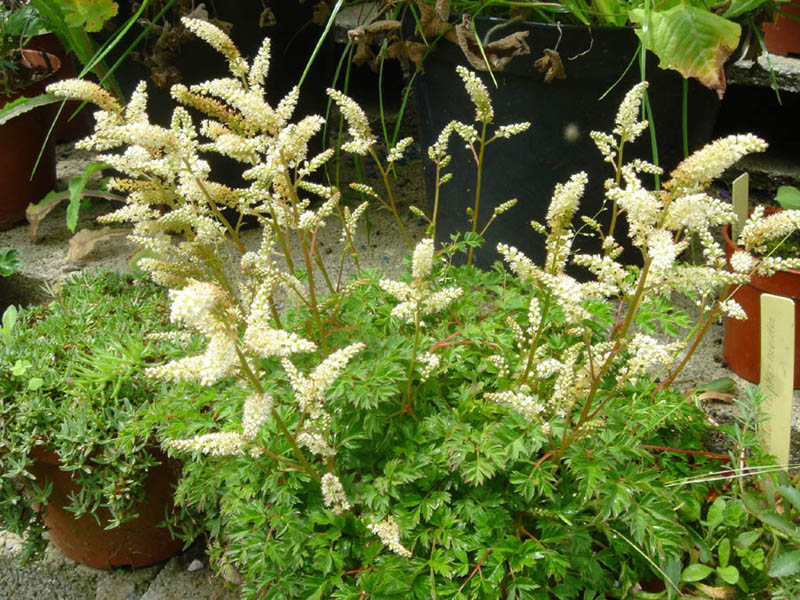
Aruncus dioicus var. aethusifolius is a compact, clump-forming herbaceous perennial reaching 8–12 inches (20–30 cm) tall with a spread of 12–18 inches (30–45 cm). Leaves are finely divided, bipinnately compound, 4–8 inches (10–20 cm) long, with small, deeply toothed leaflets 0.5–1 inch (1.3–2.5 cm) long, giving a fern-like texture. Foliage is medium green through the growing season, turning bronze to reddish-brown in fall. Short, upright panicles of tiny cream-white flowers, 3–6 inches (8–15 cm) long, appear at the stem tips in June–July. Like the species, this variety is dioecious, with male and female flowers on separate plants. Female plants produce small, dry, brown seed capsules that persist through fall. Growth rate is moderate; plants fill a 12-inch (30 cm) space within 2 years from a one-gallon container. The compact stature and fern-like foliage distinguish this variety from the species type, which reaches 48–72 inches (120–180 cm). Leaf scorch develops in full sun without consistent moisture. The plant is shorter-lived than the species type, typically requiring division every 3–4 years to maintain vigor.
Native Range
Aruncus dioicus var. aethusifolius is native to South Korea, where it occurs in moist, shaded mountain habitats on the Korean Peninsula. It grows on rocky slopes, streamside areas, and forested mountainsides at elevations of 1,000–5,000 feet (300–1,500 m).Suggested Uses
Planted as edging, ground cover, or in the front of shaded borders at 12–15 inch (30–38 cm) spacing. The fern-like texture and compact size suit rock gardens, woodland paths, and shaded container plantings. Grows in containers of at least 3 gallons (11 L) in a humus-rich, moisture-retentive mix. The compact form works in smaller garden spaces where the full-sized species would be disproportionate.How to Identify
Appearance
Size & Dimensions
Height8" - 1'
Width/Spread1' - 1'6"
Bloom Information
Cream-white flower panicles appear in June–July. Panicles are 3–6 inches (8–15 cm) long, held just above the foliage mound. Bloom duration is 3–4 weeks. Female plants produce dry, brown seed capsules that persist on the panicle through fall.
Detailed Descriptions
Foliage Description
Medium green, bronze to reddish-brown in fallGrowing Conditions
Sun Requirements
Requires 2-5 hours of direct sunlight daily
• Full Sun: 6+ hours of direct sunlight
• Partial Shade: 3-6 hours of direct sunlight
• Full Shade: Less than 3 hours of direct sunlight
Care & Maintenance
Care Guide
Plant in consistently moist, humus-rich soil in partial shade. In zones 7–8, afternoon shade prevents leaf scorch. Consistent moisture throughout the growing season maintains foliage quality; drought causes brown leaf margins and premature senescence. Divide clumps every 3–4 years in early spring when vigor decreases or the center becomes sparse. Powdery mildew may develop on foliage in humid conditions with poor air circulation. Sawfly larvae occasionally feed on foliage in early summer. Cut stems to ground level in late fall or early spring.Pruning
Cut all stems to ground level in late fall after frost browns the foliage, or in early spring before new growth emerges. The bronze-brown fall foliage can be left for seasonal interest through early winter. Spent flower panicles can be removed after bloom or left for dried texture. No mid-season pruning is required.Pruning Schedule
Prune: March & November
fallearly spring
Container Growing
Suitable for container growing
Minimum container size: 3 gallons