Image 1 of 5
© Ghislain118 http://www.fleurs-des-montagnes.net, some rights reserved (CC-BY-SA) · Wikimedia Commons
1 / 5
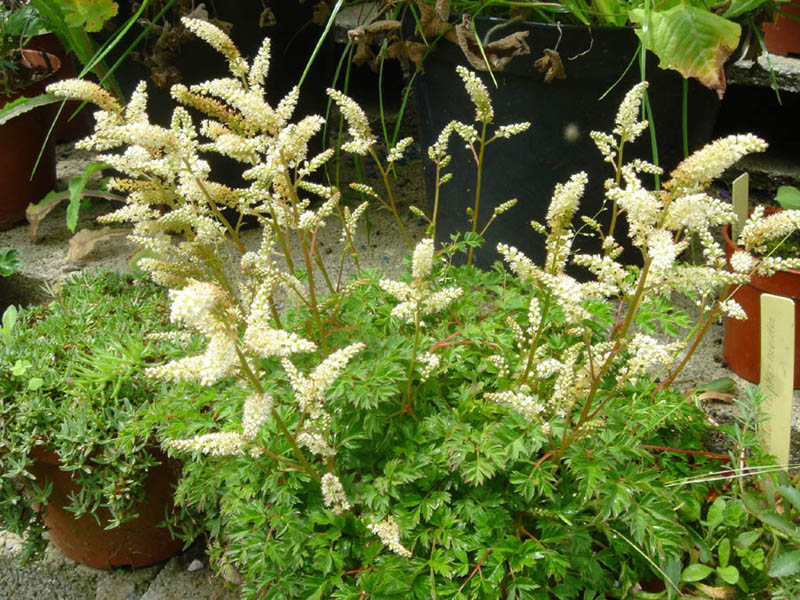
Aruncus aethusifolius
dwarf goatsbeard
Overview
Aruncus aethusifolius is a compact, clump-forming perennial in the rose family, reaching 8-12 inches (20-30 cm) tall in leaf and 12-16 inches (30-40 cm) across. The dark green leaves are finely dissected into narrow, toothed segments, giving a fern-like texture, and they turn shades of orange, red, and bronze in autumn before dying back. In early summer the plant sends up branched stems carrying narrow plumes of small creamy-white flowers, 4-8 inches (10-20 cm) long, held just above the foliage. The flower plumes resemble those of Astilbe spp., though the plant belongs to the same genus as the much larger goatsbeard A. dioicus, reaching roughly a fifth of its height. After bloom, the spent flower heads dry to a tan color and persist into autumn, and the plant may self-sow in moist ground. It grows from a tough, woody rootstock and increases slowly into denser mounds. One limitation is that the foliage scorches and browns at the edges in full sun or where the soil dries out, so it holds its texture longest in cool, consistently moist positions.
Native Range
Aruncus aethusifolius is native to the Korean Peninsula, where it grows on shaded mountain slopes, rocky stream banks, and woodland margins. It occurs in cool, moist montane habitats.Suggested Uses
Used as edging, at the front of shaded borders, in rock gardens, and in woodland plantings. It combines with hostas, ferns, and Astilbe spp. in cool, moist sites. Suitable for container plantings where the soil can be kept moist.How to Identify
Appearance
Size & Dimensions
Height8" - 1'
Width/Spread1' - 1'4"
Reaches mature size in approximately 2 years
Bloom Information
Flowering occurs in early summer, mainly June, lasting about 3-4 weeks. Branched stems carry narrow plumes of small creamy-white flowers above the foliage. The dried seed heads hold their shape and color into autumn after the flowers fade.
Detailed Descriptions
Foliage Description
Dark green, orange-bronze in autumnGrowing Conditions
Sun Requirements
Requires 3-6 hours of direct sunlight daily
• Full Sun: 6+ hours of direct sunlight
• Partial Shade: 3-6 hours of direct sunlight
• Full Shade: Less than 3 hours of direct sunlight
Care & Maintenance
Care Guide
Grow Aruncus aethusifolius in partial shade, or in full sun in cooler climates, in moist, humus-rich, well-drained soil. Keep the soil consistently moist, as drought and strong sun cause leaf edges to brown and scorch. A neutral to slightly acidic pH of 5.5 to 7.0 suits it, and a spring mulch of compost or leaf mold conserves moisture. Water during dry spells, particularly for plants in sunnier sites. The plant is slow-growing and rarely needs division, though congested clumps can be split in spring. No routine feeding is required in reasonable soil.Pruning
Cut spent flower stems back after bloom, or leave them to dry for autumn interest and self-seeding. Shear off the dried foliage in late autumn or early spring as new growth emerges. Remove self-sown seedlings if spread is not wanted.Pruning Schedule
J
F
M
A
M
J
J
A
S
O
N
D
summerfall
Container Growing
✓ Suitable for container growing
Minimum container size: 2 gallons