Ammophila, Genus, arenaria, Species,
- Genus & species
European beachgrass
Coastal western and northern Europe, the Mediterranean Basin, and North Africa
Overview
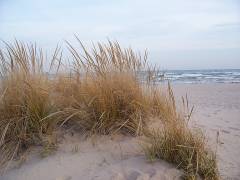
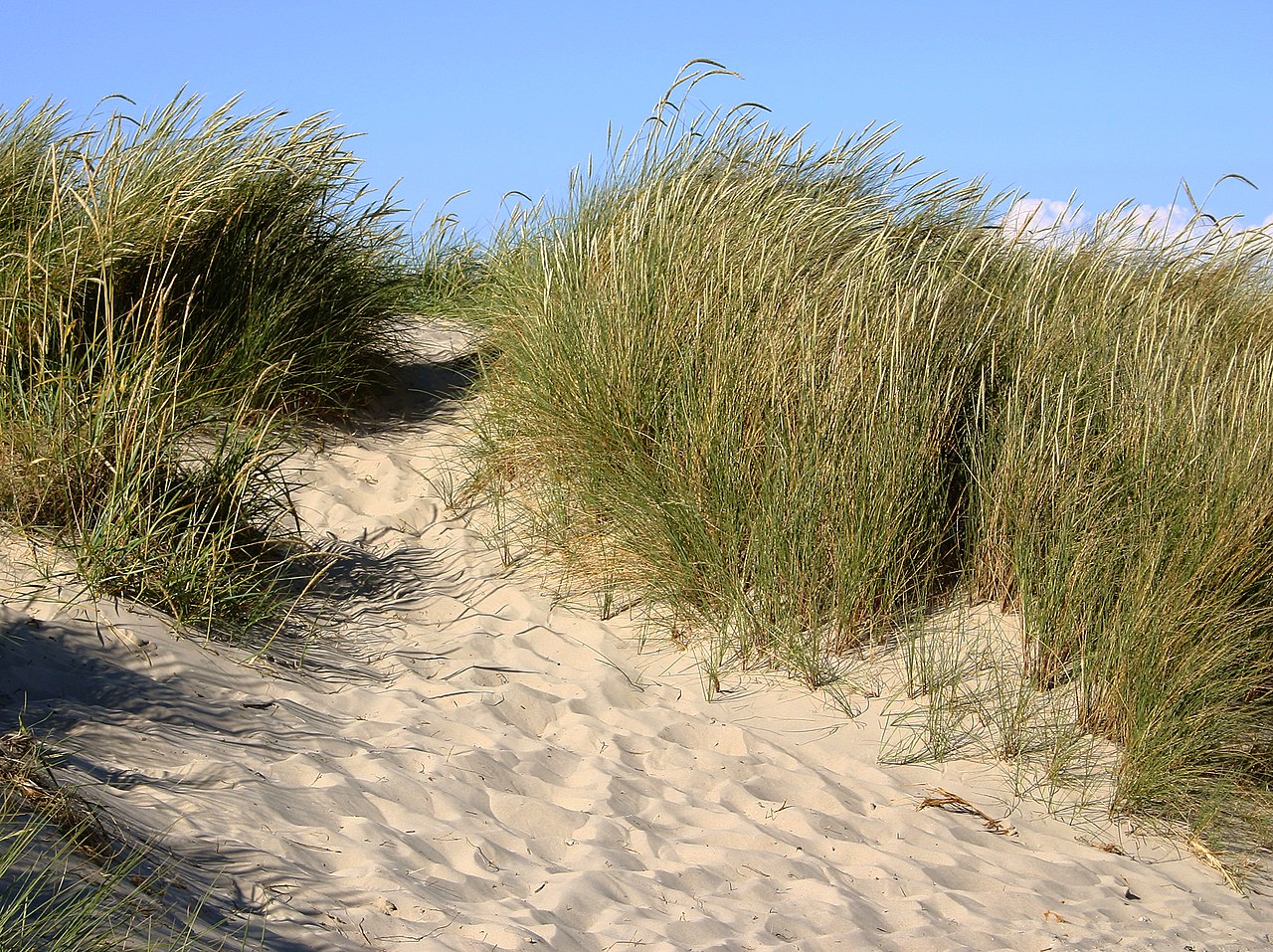
Ammophila arenaria is a rhizomatous perennial grass that forms dense tufts 24-47 inches (60-120 cm) tall, with creeping rhizomes that extend several feet through sand. The leaves are rolled inward, grey-green, stiff, and taper to a sharp point, measuring 12-24 inches (30-60 cm) long and rolling tighter as they dry to reduce water loss. Flowering stems carry a dense, spike-like panicle 6-14 inches (15-35 cm) long, straw to pale-buff colored, from June to August. The plant builds and stabilizes coastal sand dunes: as wind-blown sand buries the base, the rhizomes and stems grow upward through it, trapping more sand and raising the dune. Native to the Atlantic and Mediterranean coasts of Europe and North Africa, it has been planted for dune stabilization on other continents and has naturalized widely. On the Pacific coast of North America it spreads through coastal dune systems and displaces lower-growing native dune vegetation, and it is listed as invasive in California, Oregon, and Washington. Growth slows where sand accretion stops, and stands decline on stable, organically enriched soils. It tolerates salt spray, drought, and burial but does not persist in shade or in consistently wet ground.
Native Range
Ammophila arenaria is native to the coastal dunes of western and northern Europe, the Mediterranean Basin, and North Africa, from Scandinavia south to the Atlantic coast of Morocco. It grows on mobile and semi-fixed sand dunes along the Atlantic, North Sea, Baltic, and Mediterranean shorelines.Suggested Uses
Planted for sand dune stabilization and erosion control on coastal foredunes. Used in maritime restoration and as a windbreak grass on exposed sandy sites. Its spreading rhizomes suit large open coastal plantings rather than mixed borders.How to Identify
Appearance
Size & Dimensions
Height2' - 3'11"
Width/Spread2' - 3'
Colors
Bloom Information
Flowering stems appear from June to August, carrying a compact straw-colored panicle. The flowers are wind-pollinated and produce dry single-seeded grains that ripen by late summer. Seed set is often low in introduced populations, where spread is mainly by rhizome fragments carried in sand.
Detailed Descriptions
Flower Description
straw to pale buffFoliage Description
grey-greenGrowing Conditions
Sun Requirements
Requires 6-12 hours of direct sunlight daily
• Full Sun: 6+ hours of direct sunlight
• Partial Shade: 3-6 hours of direct sunlight
• Full Shade: Less than 3 hours of direct sunlight
Care & Maintenance
Care Guide
Ammophila arenaria grows in full sun on loose, sharp-draining coastal sand and tolerates salt spray and periodic burial. It establishes from rhizome divisions or culm cuttings pushed into moist sand, which root within a few weeks during the cool season. Vigor depends on continued sand movement; on stabilized or organically rich soils the stands thin and lose density. Supplemental water is unnecessary in maritime climates, and the grass tolerates summer drought once rooted. It spreads aggressively by rhizome and can extend beyond a planted area into adjacent dune habitat. Hardy in USDA zones 4-9, it withstands coastal frost and wind.Pruning
No routine pruning is required. Old flowering stems and weathered leaves can be cut back in late winter before new growth resumes. Cut material left on bare sand may root where nodes contact moist ground.Pruning Schedule
Prune: February–March
winter