Image 1 of 3
1 / 3
© gailhampshire from Cradley, Malvern, U.K, some rights reserved (CC-BY) · Wikimedia Commons
Ammophila, Genus, spp., Multiple species,
- Genus
- Multiple species
Marram grass
Coastal dunes of Europe, North Africa, and eastern North America
Overview
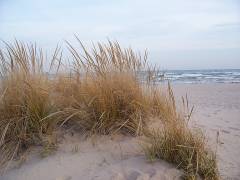
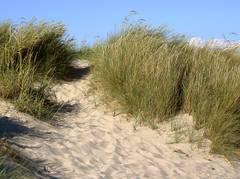
Ammophila is a small genus of rhizomatous perennial grasses, comprising two species native to coastal sand dunes of the temperate Northern Hemisphere. Plants form dense colonies from creeping rhizomes, sending up stiff, erect culms 24-47 inches (60-120 cm) tall. The leaves are tightly inrolled, gray-green, and sharply pointed, a structure that limits water loss in exposed, salt-laden sites. A. arenaria of Europe and North Africa and A. breviligulata of eastern North America both grow upward through accumulating sand, their buried stems producing new roots and shoots as dunes build. Flowering culms carry a dense, spike-like panicle 6-12 inches (15-30 cm) long, pale straw at maturity, in summer. The genus tolerates burial, wind abrasion, and salt spray but declines where sand stops accreting, and it spreads beyond its native range. A. arenaria is classed as invasive along the Pacific coast of North America, where it displaces native dune flora. Plants grow in pure sand of low fertility and full exposure, and they do not persist in shade or in stable, vegetated soils. Both species reproduce by seed and by rhizome fragments carried in moving sand.
Native Range
The genus occurs on coastal dunes of the North Atlantic and the Mediterranean. A. arenaria is native to the coasts of western and southern Europe and North Africa, while A. breviligulata is native to the Atlantic and Great Lakes shores of North America.Suggested Uses
Planted for sand stabilization on foredunes, restored beaches, and engineered dune systems. Also used in coastal gardens on deep sand where little else roots. Spreading rhizomes make it unsuited to small beds or mixed borders.How to Identify
Appearance
Size & Dimensions
Height2' - 3'11"
Width/Spread1' - 2'
Colors
Bloom Information
Flowering occurs in summer, roughly June to August. The pale, spike-like panicles persist into autumn as they dry and shed grain. Flowers are wind-pollinated and lack petals, so the display is limited to the straw-toned seed heads.
Detailed Descriptions
Foliage Description
gray-greenGrowing Conditions
Sun Requirements
Requires 6-12 hours of direct sunlight daily
• Full Sun: 6+ hours of direct sunlight
• Partial Shade: 3-6 hours of direct sunlight
• Full Shade: Less than 3 hours of direct sunlight