Image 1 of 8
1 / 8
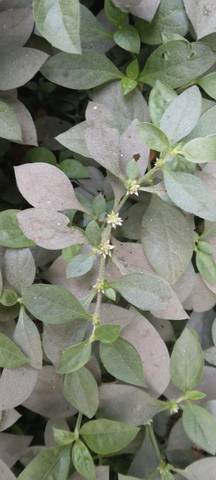
National Plant Data Center, Baton Rouge, LA 70874-4490 USA., no rights reserved (CC0) · Wikimedia Commons
Alternanthera, Genus, philoxeroides, Species,
- Genus & species
alligatorweed
Overview
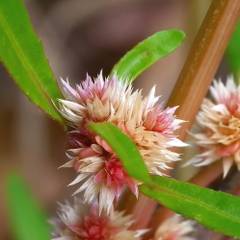
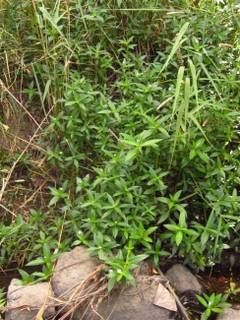
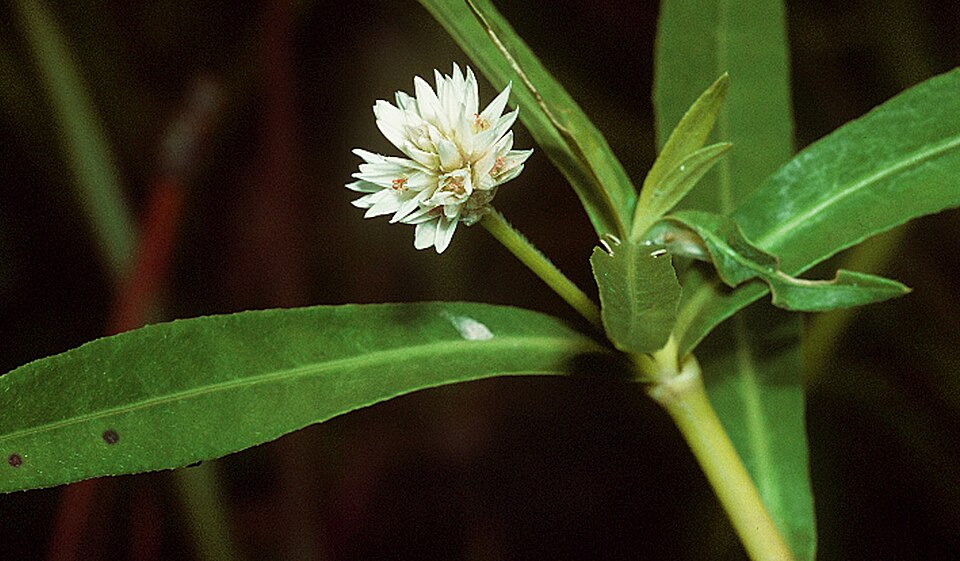
Alternanthera philoxeroides is a sprawling aquatic to semi-terrestrial perennial in the family Amaranthaceae that forms dense floating mats or rooted stands along water margins. Stems are hollow, jointed, and grow 20-60 inches (50-150 cm) long, often rooting at the nodes and branching across the water surface. Leaves are opposite, lance-shaped to elliptic, 1-4.5 inches (2.5-11 cm) long, with a smooth margin and a prominent midrib. Small flower heads form on stalks 0.4-3 inches (1-7 cm) long, each a rounded white cluster about 0.5 inch (12 mm) across resembling clover. The plant spreads almost entirely by fragmentation: broken stem pieces float, root, and establish new colonies, so seed set is rare in introduced ranges. It tolerates both standing water and saturated soil, and floating mats extend several feet over open water from a rooted base on the bank. In the United States it is listed as a federal noxious weed, and dense mats reduce water flow, shade out submerged vegetation, and lower oxygen exchange. One limitation for any managed setting is that even small stem fragments regenerate, making containment difficult once established.
Native Range
Alternanthera philoxeroides is native to the Parana River region of temperate South America, including parts of Argentina, Brazil, Paraguay, and Uruguay. It has naturalized across warm-temperate and subtropical regions of North America, Asia, Australia, and southern Europe.Suggested Uses
Alternanthera philoxeroides is not planted ornamentally and is prohibited from sale or movement in many jurisdictions. In its native range it occupies wetland margins within riparian plant communities. Where introduced, it is the target of aquatic weed-management programs rather than horticultural planting.How to Identify
Appearance
Size & Dimensions
Height1'8" - 5'
Width/Spread3' - 10'
Bloom Information
Flowering runs from late spring through summer, roughly May to September in the Northern Hemisphere. The small white heads open over an extended period but set little viable seed in introduced ranges. In frost-free climates scattered flowering continues nearly year-round.
Detailed Descriptions
Foliage Description
greenGrowing Conditions
Sun Requirements
Requires 4-12 hours of direct sunlight daily
• Full Sun: 6+ hours of direct sunlight
• Partial Shade: 3-6 hours of direct sunlight
• Full Shade: Less than 3 hours of direct sunlight