Alternanthera, Genus, denticulata, Species,
- Genus & species
lesser joyweed
Overview
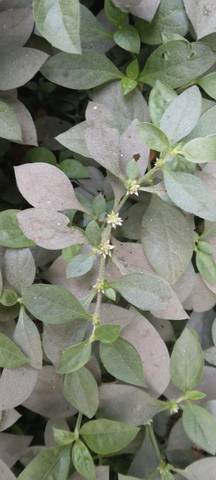
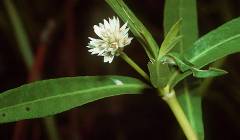
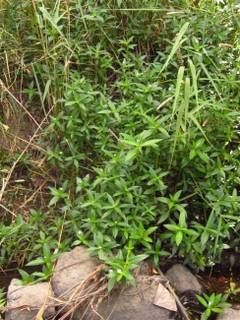
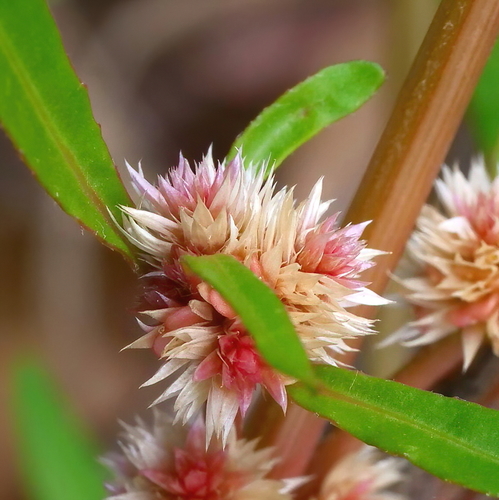
Alternanthera denticulata is a low, sprawling herb, sometimes annual and sometimes a short-lived perennial, with stems 8-24 inches (20-60 cm) long that trail along the ground or rise at the tips, rooting at the lower nodes. The opposite leaves are lance-shaped to narrow-oval, 0.6-2.4 inches (1.5-6 cm) long, green and edged with minute teeth. Small, stalkless clusters of papery white to straw-coloured flowers form tight globular heads 0.2-0.4 inch (5-10 mm) across in the leaf axils, mostly in summer and autumn. The plant spreads across damp, open ground and can root where stems touch moist soil. It grows on seasonally wet flats, drain edges, and floodplains, dying back in drought and regrowing after rain. Foliage is killed by frost, and the plant relies on seed to return in colder districts.
Native Range
Native to Australia and widespread across all mainland states and Tasmania, with related populations through the Pacific and Asia. Grows on seasonally wet ground, including floodplains, swamp edges, drainage lines, and damp disturbed sites, on clay and loam soils.Suggested Uses
Grown on pond and bog margins, in rain gardens, and on seasonally wet ground where many plants fail, spaced 12-18 inches (30-45 cm) apart. Suits damp revegetation and habitat plantings on clay soils. Its trailing, rooting stems can spread into adjacent moist beds.How to Identify
Appearance
Size & Dimensions
Height4" - 1'
Width/Spread1' - 2'
Bloom Information
Flowers mainly in summer and autumn, roughly December to April, with scattered heads after rain at other times. The small papery heads sit in the leaf axils and persist on the stem for several weeks. Flowering is heavier on consistently moist ground.
Detailed Descriptions
Flower Description
white to strawFoliage Description
greenGrowing Conditions
Sun Requirements
Requires 4-9 hours of direct sunlight daily
• Full Sun: 6+ hours of direct sunlight
• Partial Shade: 3-6 hours of direct sunlight
• Full Shade: Less than 3 hours of direct sunlight
Care & Maintenance
Care Guide
Grows in full sun to part shade on damp to wet soils, including heavy clay and ground that floods seasonally. Water to keep soil moist through the growing season, as the plant wilts and dies back in extended drought. It roots from trailing stems and self-seeds on bare, moist ground, spreading readily where conditions suit. Frost kills the top growth, and in cold districts the plant returns from seed in spring. Few pests affect it. Cutting back straggly growth in spring keeps the plant compact.Pruning
Straggly stems are cut back in spring to keep the plant low and dense. Spent flowering stems can be trimmed to limit self-seeding. No other pruning is needed on this short-lived herb.Pruning Schedule
Prune: September
early spring
Container Growing
Suitable for container growing
Minimum container size: 2 gallons