Allocasuarina, Genus, humilis, Species,
- Genus & species
dwarf sheoak
Overview
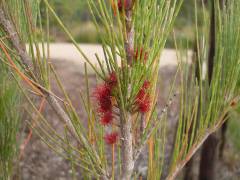
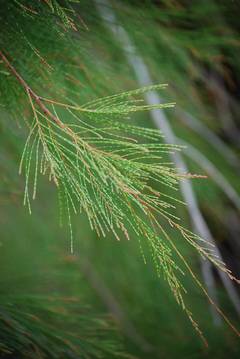
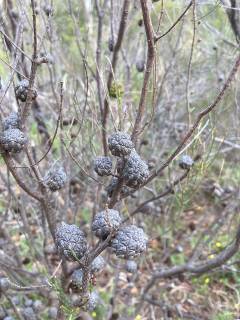
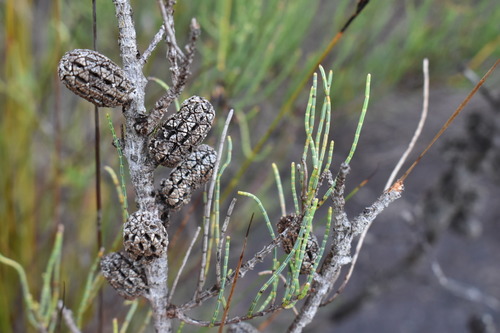
Allocasuarina humilis is a low evergreen shrub growing 1-5 feet (0.3-1.5 m) tall and 2-4 feet (0.6-1.2 m) wide, with a dense, rounded to spreading habit. Like other sheoaks, its leaves are reduced to tiny scales in whorls along jointed, needle-like green branchlets that carry out photosynthesis, giving the plant a feathery, pine-like look. The species is dioecious: male plants produce rusty-brown flower spikes at the branchlet tips, while female plants bear small red flowers that develop into woody, barrel-shaped cones 0.6-1.2 inches (1.5-3 cm) long holding winged seeds. The cones stay closed on the plant until fire or death triggers their opening. Allocasuarina humilis grows in sandy heath and kwongan shrubland across southwestern Western Australia and tolerates drought, poor sandy soils, and salt-laden wind. It fixes nitrogen through root associations, helping it grow on infertile ground, but has low tolerance of waterlogging and heavy shade. In gardens it is used as a low screen, habitat shrub, and erosion binder on dry sandy sites.
Native Range
Allocasuarina humilis is native to southwestern Western Australia, where it is widespread in sandy heath and kwongan shrubland on the coastal plain and adjacent ranges. It grows on deep sands and lateritic soils in open, sunny positions.Suggested Uses
A. humilis is used as a low screen, windbreak, and habitat shrub in dry, sandy, and coastal native gardens, and for stabilising sandy banks. Its cones and branchlets shelter and feed small birds. Free-draining sites suit it, while heavy or wet soils do not.How to Identify
Appearance
Size & Dimensions
Height1' - 5'
Width/Spread2' - 4'
Bloom Information
Rusty-brown male flower spikes and small red female flowers appear mainly from autumn to spring, with timing varying by season. Male and female flowers grow on separate plants, so both are needed for seed. Wind carries the pollen, and woody cones develop on female plants over the following months.
Detailed Descriptions
Flower Description
Rusty brown male, red femaleFoliage Description
Green branchletsGrowing Conditions
Sun Requirements
Requires 6-10 hours of direct sunlight daily
• Full Sun: 6+ hours of direct sunlight
• Partial Shade: 3-6 hours of direct sunlight
• Full Shade: Less than 3 hours of direct sunlight
Care & Maintenance
Care Guide
Grow A. humilis in full sun on free-draining sandy or gravelly soil of low fertility. It tolerates drought, coastal wind, and poor ground once established, and fixes its own nitrogen, but is damaged by waterlogging and deep shade. The shrub suits USDA zones 9-11 and withstands light to moderate frost. Water through the first summer to settle the roots, then rely on rainfall. Phosphorus-rich fertilisers harm this and many other native species.Pruning
A. humilis tolerates light pruning to shape the shrub and encourage density. Trim after flowering, cutting only into green branchlets, as old bare wood reshoots slowly. Light annual tip pruning keeps plants compact and bushy.Pruning Schedule
Prune: October–November
spring
Container Growing
Suitable for container growing
Minimum container size: 5 gallons