Image 1 of 6
1 / 6
© John Tann from Sydney, Australia, some rights reserved (CC-BY) · Wikimedia Commons
Allocasuarina, Genus, spp., Multiple species,
- Genus
- Multiple species
sheoaks
Overview
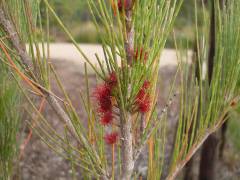
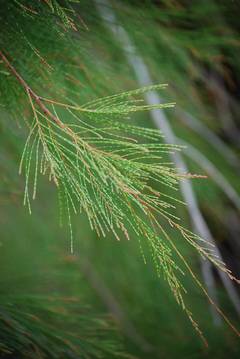
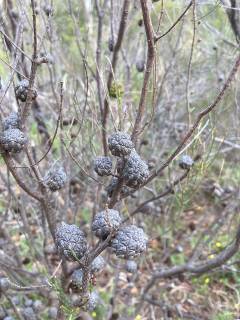
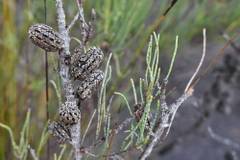
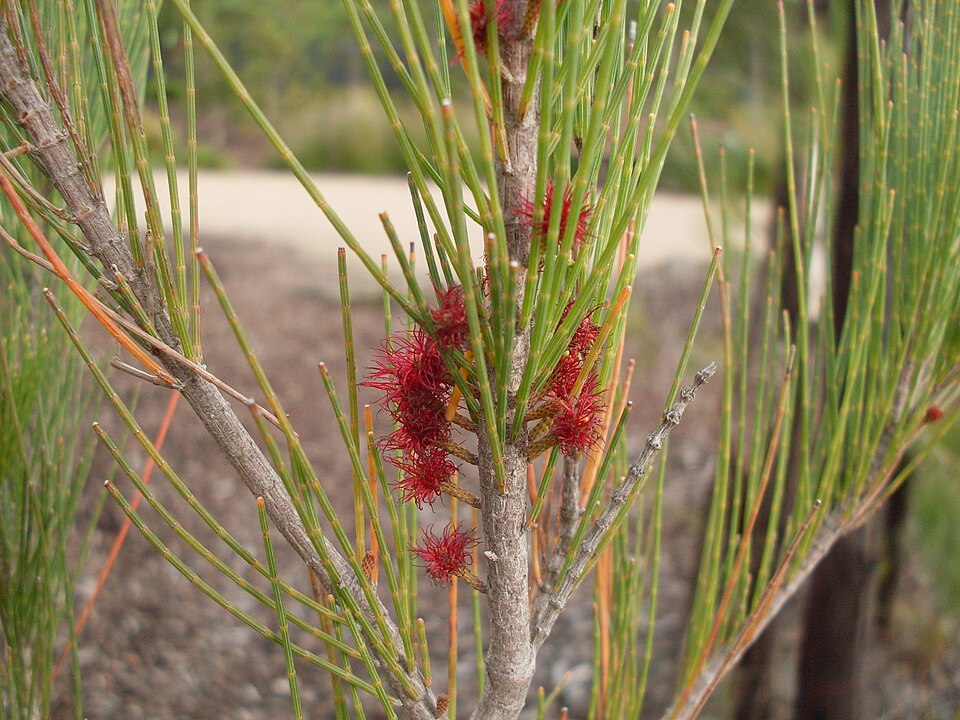
Allocasuarina is a genus of about 60 species of evergreen trees and shrubs in the family Casuarinaceae, all native to Australia. Plants range from low spreading shrubs 3 ft (0.9 m) high to trees reaching 35-50 ft (11-15 m), with a slender, drooping, conifer-like outline. What appear to be needles are green photosynthetic branchlets divided into jointed segments; the true leaves are reduced to tiny scales arranged in whorls at each joint. Most species are dioecious, carrying male and female flowers on separate plants, the males as brownish spikes at branchlet tips and the females as small red tufts that develop into woody, cone-like fruiting bodies 0.4-1.6 in (1-4 cm) long. The seeds are winged and shed from the woody cones after they dry. Roots form nitrogen-fixing nodules with Frankia bacteria, letting the plants colonise nutrient-poor sand and rock. The genus spans most Australian habitats, from coastal heath and dunes to inland woodland and rocky ranges. Many species are slow-growing and tolerate drought, salt, and wind once established, though most are frost-sensitive when young and grow poorly in heavy, waterlogged soils.
Native Range
All species are endemic to Australia, where the genus is widespread across the continent. They occur in coastal heath and dunes, sclerophyll woodland, and rocky inland ranges, often on sandy or skeletal soils.Suggested Uses
Used for windbreaks, erosion control on sandy or degraded ground, and as screening or specimen trees in low-water gardens. Smaller shrubby species are grown in coastal and native plantings where salt and drought limit other choices.How to Identify
Appearance
Size & Dimensions
Height3' - 50'
Width/Spread3' - 25'
Colors
Bloom Information
Flowering varies by species and region but often falls in autumn through winter, when male plants turn rusty-brown with pollen spikes and females show small red styles. Wind carries the pollen between separate male and female plants. Woody cones develop over several months and can hold seed on the plant for a year or more.
Detailed Descriptions
Flower Description
brown (male), red (female)Foliage Description
green to grey-greenGrowing Conditions
Sun Requirements
Requires 6-12 hours of direct sunlight daily
• Full Sun: 6+ hours of direct sunlight
• Partial Shade: 3-6 hours of direct sunlight
• Full Shade: Less than 3 hours of direct sunlight
Care & Maintenance
Care Guide
Most species grow in full sun and sharply drained sandy or rocky soils of low fertility, drawing nitrogen from root-borne Frankia bacteria rather than the soil. Established plants tolerate drought, coastal salt, and wind, which fits them to exposed sites. Heavy, wet, or compacted soils cause poor growth and root disease. Young plants are frost-sensitive and need protection in their first seasons in cool climates. Watering is needed only to establish, and mature plants rarely require irrigation. Growth is generally slow, and shed branchlets build up as litter beneath established plants.Pruning
Light shaping can be done after flowering, as plants tolerate trimming of the branchlets but reshoot slowly from bare older wood. Lower branches of tree species are sometimes removed to lift the canopy, though cuts into thick wood heal slowly.Pruning Schedule
Prune: June–July
winter