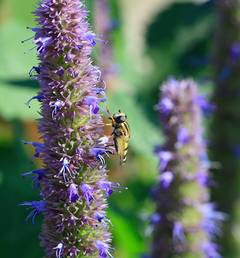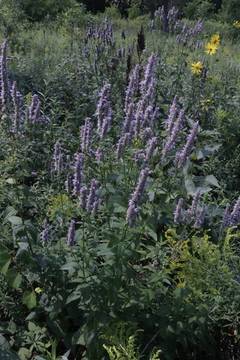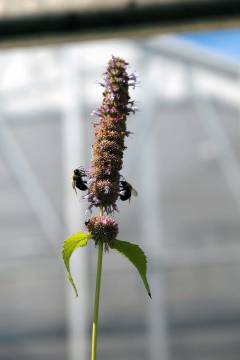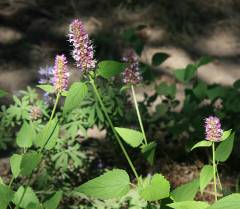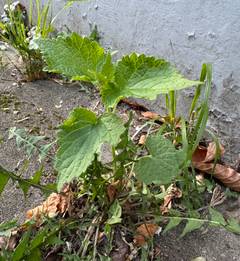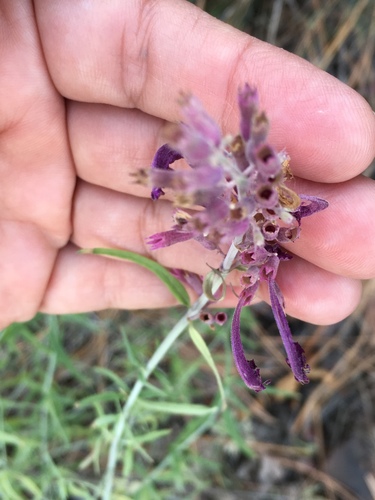
Agastache, Genus, rupestris, Species,
- Genus & species
sunset hyssop
Southwestern United States (Arizona, New Mexico)
Overview
Agastache rupestris is a mounding, semi-woody perennial reaching 18–30 inches (45–75 cm) tall and 18–24 inches (45–60 cm) wide. Stems are square in cross-section and branch freely from a woody base. Leaves are narrow and silver-gray to gray-green, 0.5–1 inch (1.3–2.5 cm) long, and release a licorice-mint scent when brushed or crushed. Flower spikes 4–8 inches (10–20 cm) long carry salmon-orange tubular corollas 0.5–0.75 inch (1.3–2 cm) long emerging from persistent lavender calyces; the two-toned pairing of orange petals against lavender calyces remains visible for 2–3 weeks after the petals drop, as the calyces retain their color. Bloom runs from July through October, with continuous flower production over 8–10 weeks. Plants self-seed modestly in loose, well-drained soils. Growth rate is rapid, and plants reach mature size within 1–2 growing seasons; stems become semi-woody at the base with age. Crown hardiness reaches USDA zone 5 in sharply drained soils. Limitation: plants are typically short-lived at 3–5 years in humid climates with heavy or wet winter soils, where root rot develops rapidly in waterlogged conditions and clay soils can prevent zone 5 overwintering regardless of air temperature.
Native Range
Native to the southwestern United States in Arizona and New Mexico, growing on dry rocky slopes, cliff faces, and canyon walls at 5,000–8,000 feet (1,500–2,400 m) elevation in well-drained mineral soils.Suggested Uses
Used in rock gardens, xeric borders, gravel gardens, and pollinator plantings at 18–24 inch (45–60 cm) spacing. The long summer-through-fall bloom period supplies nectar for hummingbirds, bumblebees, and butterflies during mid and late summer. Lean rocky soils and full sun suit the species. Heavy clay, irrigated beds, and humid-winter climates without sharp drainage are unsuitable.How to Identify
Appearance
Size & Dimensions
Height1'6" - 2'6"
Width/Spread1'6" - 2'
Bloom Information
Flowers open from July through October in zones 5–9, with continuous bloom production over 8–10 weeks. Individual flower spikes produce new buds progressively; petals drop while the lavender calyces persist for 2–3 additional weeks. In zone 9, bloom begins in late June. Flowering slows when night temperatures consistently drop below 45°F (7°C).
Detailed Descriptions
Flower Description
salmon-orange tubular corollas emerging from persistent lavender calycesFoliage Description
silver-gray to gray-green; narrow, 0.5-1 inch (1.3-2.5 cm) long; aromatic with a licorice-mint scent when crushedGrowing Conditions
Sun Requirements
Requires 6-12 hours of direct sunlight daily
• Full Sun: 6+ hours of direct sunlight
• Partial Shade: 3-6 hours of direct sunlight
• Full Shade: Less than 3 hours of direct sunlight
Care & Maintenance
Care Guide
Site in full sun with 6 or more hours of direct sun per day in well-drained sandy, loamy, or rocky soil with a pH of 6.0–8.0. Water sparingly once established; overwatering is the primary cause of plant decline and root rot. Heavy soils should be amended at planting with coarse gravel or pumice to improve drainage; clay soils without amendment are unsuitable. Fertilization is not required and excess nutrients produce soft growth susceptible to winter kill. Stems become lax and flowering drops in shade. Spider mites develop in hot, stagnant conditions. Plants are typically short-lived at 3–5 years in the Pacific Northwest and other humid-winter climates. Hardy in USDA zones 5–9 with sharp drainage.Pruning
Cut stems back to 4–6 inches (10–15 cm) above ground in early spring (March and April) after the last hard frost but before new growth emerges. Fall pruning is not recommended because dried stems shield the woody crown from winter moisture. Deadheading during the growing season can extend bloom. Self-sown seedlings can be transplanted or removed in spring.Pruning Schedule
Prune: March–April
early spring
Container Growing
Suitable for container growing
Minimum container size: 3 gallons