Acianthus, Genus, pusillus, Species,
- Genus & species
small mosquito-orchid
Overview
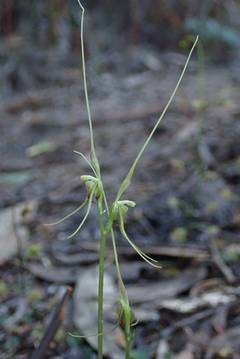
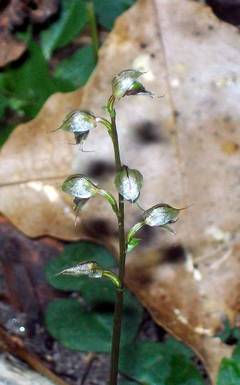
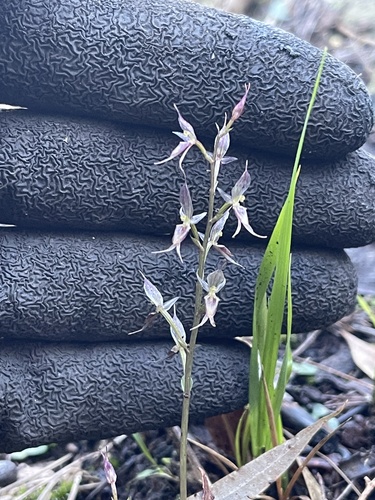
Acianthus pusillus is a small terrestrial tuberous orchid that forms colonies on the forest floor. Each plant produces a single heart-shaped leaf 0.4-1.2 inches (10-30 mm) wide, held flat against the ground, dark green above and purplish-red beneath. A wiry flowering stem 1.5-5 inches (4-12 cm) tall rises from the leaf, carrying 3 to 15 tiny translucent flowers, each about 0.2 inch (5 mm) long, dark reddish to greenish with a pointed dorsal sepal and narrow spreading segments. Flowering occurs in autumn and winter, when the plant grows from its dormant tuber; the leaf and stem wither by late spring as the plant returns to dormancy through summer. Flowers are pollinated by fungus gnats drawn to their colour and scent. Like other ground orchids, it depends on a symbiotic soil fungus and rarely survives transplanting. Colonies can number many plants but are easily overlooked because of the small, dark flowers held close to the leaf litter.
Native Range
Native to southeastern Australia, including Victoria, Tasmania, southern New South Wales, and southeastern South Australia. Grows in moist, shaded leaf litter of eucalypt forest, woodland, and coastal scrub, usually in sandy or loamy soils rich in organic matter.Suggested Uses
Grown by terrestrial-orchid specialists in containers that mimic its seasonal cycle and fungal associations. Occurs in bushland conservation and forest-floor settings rather than cultivated beds. Not suited to general garden borders or open, sunny positions.How to Identify
Appearance
Size & Dimensions
Height2" - 5"
Width/Spread1" - 2"
Bloom Information
Detailed Descriptions
Flower Description
reddish to green, translucentFoliage Description
dark green, purple beneathGrowing Conditions
Sun Requirements
Requires 1-4 hours of direct sunlight daily
• Full Sun: 6+ hours of direct sunlight
• Partial Shade: 3-6 hours of direct sunlight
• Full Shade: Less than 3 hours of direct sunlight
Care & Maintenance
Care Guide
Emerges from a dormant tuber with autumn rains, grows and flowers through the cooler months, and dies back to the tuber by late spring. It needs moist, humus-rich, well-drained soil and shade during active growth, and drier conditions through summer dormancy. The plant depends on a specific mycorrhizal fungus, which makes cultivation outside its native habitat difficult. It grows under the part to full shade of an open forest canopy. Colonies decline when leaf litter is removed or the soil is disturbed or compacted.Pruning
No pruning is applicable. The leaf and flowering stem die back naturally into summer dormancy, and the surrounding leaf litter can remain undisturbed over the dormant tubers.Container Growing
Suitable for container growing
Minimum container size: 1 gallons