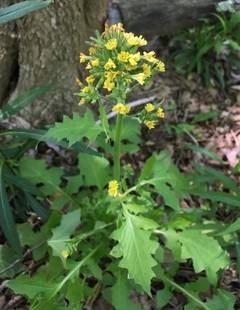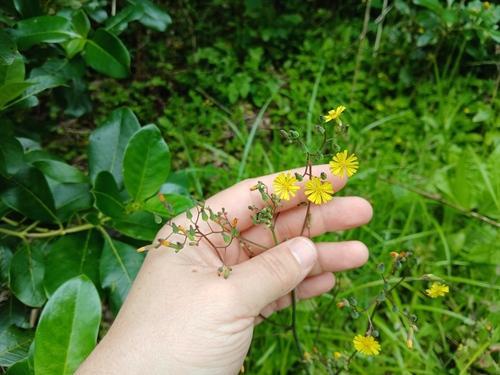
Youngia, Genus, japonica, Species,
- Genus & species
oriental false hawksbeard
SunFull Sun – Part Shade
WaterMedium
Overview
Youngia japonica is an annual or short-lived biennial in the aster family, forming a flat basal rosette from which one or more slender flowering stems rise 4-40 inches (10-100 cm) tall. Rosette leaves are 2-8 inches (5-20 cm) long, lyre-shaped with a large terminal lobe and smaller side lobes, resembling those of dandelion. The upper stems are nearly leafless and branch into open clusters of many small flower heads. Each head is about 0.2-0.3 inch (5-8 mm) across with yellow ray florets and no disk florets, opening in the morning. Flowers give way to tufted seeds carried on white pappus and dispersed by wind. The plant completes its cycle quickly and can produce several generations a year in mild climates. It grows in lawns, gardens, pavement cracks, and other disturbed ground, and self-seeds heavily enough to become weedy. A single plant can set thousands of seeds. The shallow taproot is easily pulled when young.
Native Range
Youngia japonica is native to eastern and southeastern Asia. It has naturalized widely in warm regions of the world, including the southeastern United States, where it grows in lawns, fields, and disturbed urban ground.Suggested Uses
Rarely planted intentionally, this species appears mainly as a volunteer in lawns and disturbed ground. The young rosette leaves are eaten as a cooked green in parts of Asia. Small bees collect pollen from the flowers in mild-winter regions.How to Identify
Appearance
Size & Dimensions
Height4" - 3'4"
Width/Spread4" - 1'
Bloom Information
Flowering occurs from spring through autumn, and nearly year-round in frost-free climates. The small yellow heads open in the morning and close later in the day. Seed heads form continuously, so flowers and seeds appear together on the same plant.
Detailed Descriptions
Foliage Description
greenGrowing Conditions
Sun Requirements
Requires 4-10 hours of direct sunlight daily
• Full Sun: 6+ hours of direct sunlight
• Partial Shade: 3-6 hours of direct sunlight
• Full Shade: Less than 3 hours of direct sunlight
Water & Climate
Water Needs
Care & Maintenance
Care Guide
Plants grow in full sun to part shade and tolerate a wide range of soils, growing fastest in moist, fertile ground. They need no special care and often appear on their own in lawns and beds. Regular mowing reduces flowering but does not eliminate the low rosette. Hand-pulling before seed set is the usual way to limit spread, as each plant produces abundant wind-borne seed. The species grows as a cool-season annual in hot climates and a warm-season annual farther north. It completes its life cycle in a single season.Pruning
Removing flowering stems before the seed heads ripen prevents self-seeding. Mowing or shearing the rosette keeps plants from flowering, though they regrow from the crown. No other pruning is needed.Toxicity
Non-toxicPlanting Guide
Planting Methods & Timing
Planting Method
direct sow