Xerophyllum, Genus, tenax, Species,
- Genus & species
beargrass
Pacific Northwest and Northern Rockies
Overview
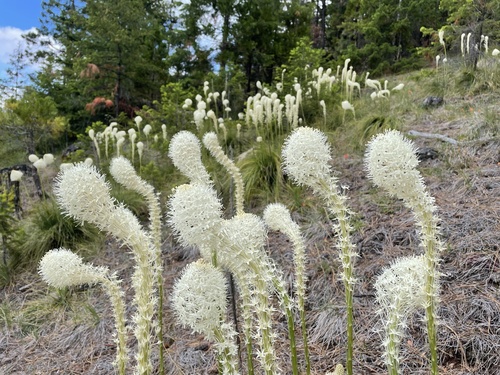
Xerophyllum tenax is a clump-forming perennial reaching 12-30 inches (30-75 cm) tall when not in flower and 3-6 feet (90-180 cm) tall when blooming, with basal clumps spreading 2-3 feet (60-90 cm) wide. Foliage forms dense tussocks of grass-like leaves 12-24 inches (30-60 cm) long and 1/8-1/4 inch (3-6 mm) wide, with rough, finely serrated margins that arch outward from a central crown. Leaves are deep green, evergreen, and tough — historically used by Indigenous peoples of the Pacific Northwest for basketry. Plants flower irregularly, typically every 5-7 years; non-flowering crowns persist between bloom cycles. When flowering, a single stout stalk emerges in late spring carrying a dense raceme of small, cream-white flowers 12-24 inches (30-60 cm) long. After flowering, the entire flowering crown dies; new offsets at the base continue the clump. Plants take 7-10 years to first flower from seed. Beargrass resprouts from underground rhizomes after wildfire, and post-fire flowering can be synchronous across whole hillsides.
Native Range
Native to western North America from southern British Columbia south through Washington, Oregon, and California, east to Idaho, western Montana, and Wyoming. Found in subalpine meadows, open coniferous forests, and burn sites at 1,500-7,000 feet (450-2,100 m) elevation. Most abundant on slopes with cool summers, snowy winters, and acid, well-drained soils derived from granitic or volcanic substrate.Suggested Uses
Used in native meadow restoration projects, alpine and rock gardens, and dry shade plantings in zones 5-8 at 24-36 inch (60-90 cm) spacing. Plants persist on roadside cuts and slope stabilization sites where summer water is limited. Container culture is rarely successful long-term due to root-zone heat sensitivity.How to Identify
Appearance
Size & Dimensions
Height1' - 6'
Width/Spread2' - 3'
Bloom Information
Late May through July in zones 5-8 depending on elevation and snowmelt; coastal and low-elevation plants bloom late May through June, montane populations into mid-July. Individual flower stalks open from the base upward over 2-3 weeks. Synchronous mass-flowering events occur 1-2 years after wildfire across burned slopes.
Detailed Descriptions
Foliage Description
deep greenGrowing Conditions
Sun Requirements
Requires 4-12 hours of direct sunlight daily
• Full Sun: 6+ hours of direct sunlight
• Partial Shade: 3-6 hours of direct sunlight
• Full Shade: Less than 3 hours of direct sunlight
Care & Maintenance
Care Guide
Grows in full sun to partial shade on acid, well-drained soils high in coarse sand or gravel content. Cool root-zone temperatures are critical; plants decline rapidly where summer soil temperatures exceed 75°F (24°C). Water sparingly during the first season to establish; mature plants survive on natural rainfall in zones 5-8 and are killed by summer irrigation in heavy soils. Plants are slow to establish from seed and take 7-10 years to bloom for the first time. Crown rot occurs in soils with pH above 7.0 or in poorly drained sites. Beargrass does not transplant from the wild and rarely survives the move; container-grown plants from rhizome divisions are typical.Pruning
No structural pruning is performed; the central crown that flowered will die naturally over 12-18 months and offsets at the base continue the clump. Spent flower stalks are cut at the base after seed has dispersed in late summer for tidiness or left standing through winter. Yellowing leaves can be combed out of the clump by hand annually in early spring; cutting all leaves to ground level damages the crown and is rarely successful.Pruning Schedule
Prune: August–September
fall