Overview
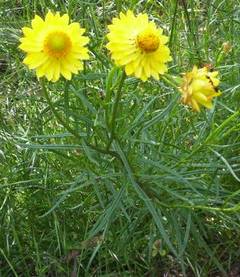
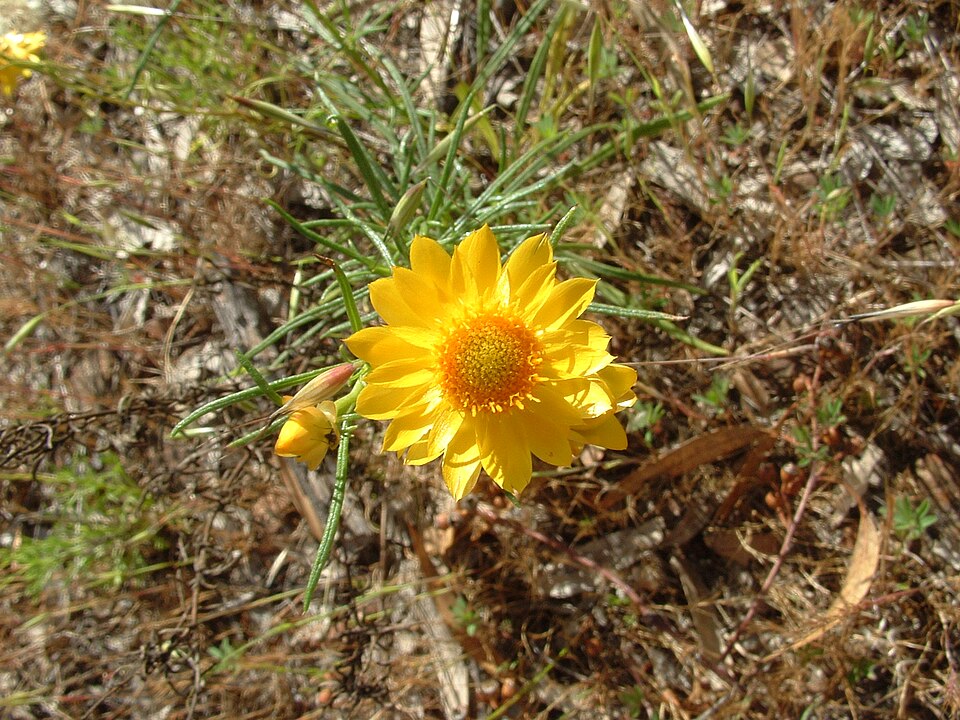
Xerochrysum viscosum is an erect annual to short-lived perennial herb 30-90 cm (12-35 in) tall, with stiff sparsely branched stems and sticky aromatic foliage. The narrow lance-shaped leaves are 2-7 cm (0.8-2.8 in) long, dark green, rough and resinous to the touch, clasping the stem. From spring into summer each stem is topped by daisy-like flower heads 2-4 cm (0.8-1.6 in) wide; what look like petals are stiff papery golden-yellow bracts surrounding a central disc of tiny true flowers. The papery bracts keep their colour when dried, the source of the everlasting name. It grows in open forest, woodland, grassland, and disturbed ground in southeastern Australia, on a range of well-drained soils, and often colonises roadsides and cleared sites. Quick to grow from seed, it is raised for cut and dried flowers but is short-lived, often persisting only a year or two before needing renewal from seed.
Native Range
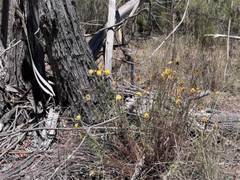
Native to southeastern Australia, including Queensland, New South Wales, Victoria, Tasmania, and South Australia, in open forest, woodland, grassland, and disturbed ground on well-drained soils.Suggested Uses
Grown in cottage and native flower borders, wildflower meadows, and low-water gardens, and widely for cut and dried floristry. Its quick growth suits seasonal colour and self-seeding drifts rather than permanent structure.How to Identify
Appearance
Size & Dimensions
Height1' - 2'11"
Width/Spread8" - 1'4"
Bloom Information
Golden-yellow papery flower heads appear from spring into summer, mainly October to February, each head 2-4 cm wide on an upright stem. The stiff bracts hold their colour for weeks and persist when dried. Removing spent heads extends the display.
Detailed Descriptions
Foliage Description
Dark greenGrowing Conditions
Sun Requirements
Requires 6-12 hours of direct sunlight daily
• Full Sun: 6+ hours of direct sunlight
• Partial Shade: 3-6 hours of direct sunlight
• Full Shade: Less than 3 hours of direct sunlight
Water & Climate
Water Needs
Drought Tolerance
Drought tolerant when established
Care & Maintenance
Care Guide
Grows quickly in full sun on most well-drained soils, including poor and sandy ground, and tolerates drought once established. It dislikes wet, heavy soils and shade, where it grows weakly and flops. Young plants need watering until established, after which little is needed beyond dry-spell watering. Light feeding supports flowering on poor soils. Being short-lived, it is often resown each year or left to self-seed.Pruning
Removing spent flower heads prolongs blooming and keeps the plant tidy. Cutting stems for fresh or dried arrangements also encourages more flowers. Plants can be cut back lightly after the main flush.Container Growing
Suitable for container growing
Toxicity
Non-toxicPlanting Guide
Planting Methods & Timing
Planting Method
both
Direct Sow Timing
Spring, after the last frost
Plant Spacing
12 inches