Wollemia, Genus, nobilis, Species,
- Genus & species
Wollemi pine
Overview
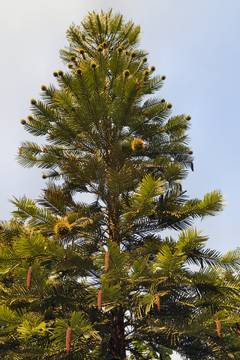
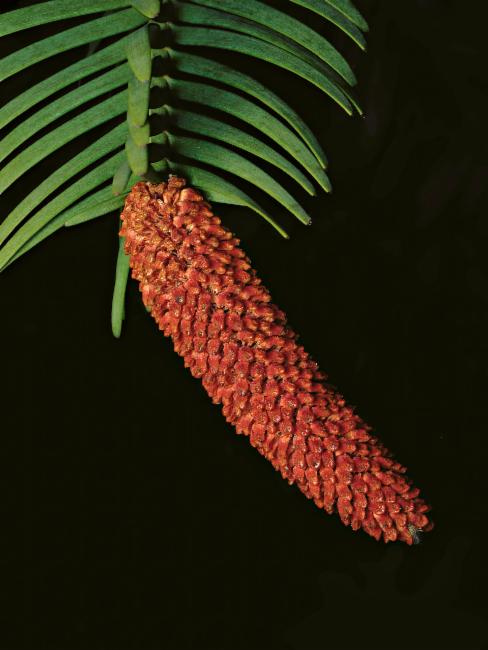
Wollemia is a monotypic genus of evergreen conifer in the family Araucariaceae, containing the single species Wollemia nobilis, native to a few small groves in eastern Australia. In the wild it reaches 80-130 feet (24-40 m) tall, often with several trunks from the base; cultivated specimens are usually far smaller and slower. The bark is dark chocolate-brown and covered in small spongy nodules. The leaves are flattened, soft, and 0.5-3 inches (1.5-8 cm) long, arranged in two to four ranks along the shoots to give a fern-like spray, emerging bright lime-green and aging to deep green. New buds are coated in a white waxy cap in winter that protects the growing point. Pollen cones hang at the tips of lower branches and rounded seed cones sit upright on higher ones, the seed cones breaking apart when ripe. The species was known only as a fossil until living trees were found in 1994 and remains very rare in the wild. It tolerates light frost once established but is damaged by hard freezes, and young plants need shelter and free-draining soil.
Native Range
Native to a small area of the Blue Mountains in New South Wales, Australia, where fewer than 100 mature trees survive in a few sheltered sandstone canyons. It grows in deep, moist, shaded gorges on damp, acidic, sandy soils, alongside temperate rainforest species.Suggested Uses
Grown as a specimen tree in lawns, parks, and large gardens in mild climates, and as a container plant that can be moved under cover where winter frost is hard, set well clear of buildings for its eventual height. It also grows as a conservatory or large indoor plant in bright light. Its rarity has made it a collector and conservation planting.How to Identify
Appearance
Size & Dimensions
Height80' - 130'
Width/Spread20' - 40'
Bloom Information
As a conifer, Wollemia bears cones rather than flowers. Pollen cones form at the tips of lower branches and rounded seed cones sit upright on higher branches, with pollen typically shed in spring. The seed cones ripen over many months and break apart on the tree to release winged seeds, though cultivated plants seldom cone while young.
Detailed Descriptions
Foliage Description
lime-green aging to deep greenGrowing Conditions
Sun Requirements
Requires 4-9 hours of direct sunlight daily
• Full Sun: 6+ hours of direct sunlight
• Partial Shade: 3-6 hours of direct sunlight
• Full Shade: Less than 3 hours of direct sunlight
Care & Maintenance
Care Guide
Grows in full sun to part shade in moist, well-drained, acidic to neutral soil with a pH from 5.0 to 7.0; it fails in dry, alkaline, or waterlogged ground. Steady moisture supports establishment, after which it tolerates short dry spells but not prolonged drought. The tree withstands light frost once established but is damaged below about 20 F (-7 C), so young plants are sheltered or grown in containers in cold regions. Shelter from drying wind protects the soft foliage. Growth is slow to moderate, and little feeding is needed in reasonable soil. Phytophthora root rot is a serious risk in wet, poorly drained soil, so sharp drainage is important.Pruning
Little pruning is needed, as the tree forms its tiered, often multi-stemmed shape on its own. Dead or damaged branches are removed in late winter while dormant. Removing lower limbs is tolerated, and container plants can be kept compact by restricting root space rather than heavy cutting.Pruning Schedule
Prune: February
winter
Container Growing
Suitable for container growing
Minimum container size: 10 gallons