Wikstroemia, Genus, indica, Species,
- Genus & species
bootlace plant
Overview
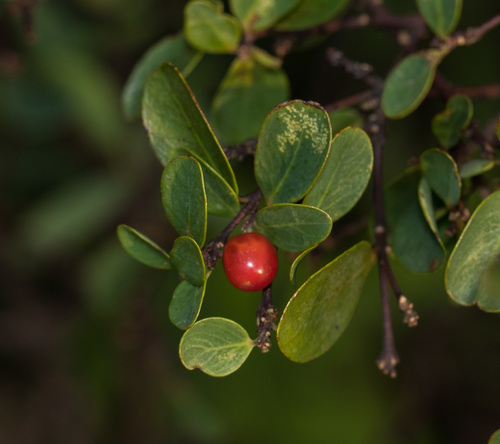
Wikstroemia indica is an evergreen shrub reaching 3-6 feet (0.9-1.8 m) tall and 2-5 feet (0.6-1.5 m) wide, with slender, flexible branches and tough, fibrous bark that resists breaking by hand. Leaves are opposite, oblong to elliptic, 0.5-2 inches (1.3-5 cm) long, thin-textured, dark green above and paler beneath. Small yellow-green tubular flowers about 0.3 inch (8 mm) long are borne in short terminal clusters and lack spreading petals, the colour coming from the tubular calyx. Flowering and fruiting continue over much of the year in warm climates. Flowers are followed by fleshy, egg-shaped fruit 0.2-0.4 inch (5-10 mm) long that ripen orange-red to bright red. All parts contain daphnane-type diterpene compounds and are toxic to humans and pets if ingested, and the sap can irritate skin. The fibrous bark has been used to make cordage and rough string. The shrub establishes in disturbed ground and is recorded as an environmental weed in Hawaii and parts of eastern Australia.
Native Range
Native to a broad area of Asia and the western Pacific, from India and southern China through Southeast Asia to northern and eastern Australia and many Pacific islands. Grows in coastal scrub, forest margins, and disturbed ground from sea level to middle elevations. Naturalized and weedy in Hawaii and parts of eastern Australia.Suggested Uses
Used occasionally as a low hedge or coastal screen in frost-free gardens, spaced 24-36 inches (60-90 cm) apart, though its weediness limits planting in many regions. The fibrous bark has been used traditionally for cordage and string. All parts are toxic if eaten, which restricts use where children or pets are present.How to Identify
Appearance
Size & Dimensions
Height3' - 6'
Width/Spread2' - 5'
Bloom Information
Flowers and fruits through much of the year in frost-free climates, with peaks in spring and summer. In cooler parts of its range, flowering concentrates from spring to autumn. Flowers and ripe red fruit are often present on the plant at the same time.
Detailed Descriptions
Foliage Description
dark greenGrowing Conditions
Sun Requirements
Requires 4-9 hours of direct sunlight daily
• Full Sun: 6+ hours of direct sunlight
• Partial Shade: 3-6 hours of direct sunlight
• Full Shade: Less than 3 hours of direct sunlight
Care & Maintenance
Care Guide
Grows in full sun to part shade in a range of well-drained soils, including sandy and rocky coastal sites. Water during establishment; established plants tolerate dry periods and salt-laden wind. It grows on poor soils without supplementary feeding in most settings. Few pests trouble it. The shrub self-seeds where birds spread the fleshy fruit, forming naturalized stands in mild climates. All parts are toxic if eaten and the sap can irritate skin.Pruning
Prune after the main flush of fruiting to control size and shape; the flexible stems tolerate regular trimming. Cut stems exude a sap that can irritate skin on contact. Plants reshoot from the woody base after hard pruning.Pruning Schedule
Prune: March–April
fall
Container Growing
Suitable for container growing
Minimum container size: 3 gallons