Wikstroemia, Genus, spp., Multiple species,
- Genus
- Multiple species
akia
Asia, the Pacific Islands including Hawaii, and Australia
Overview
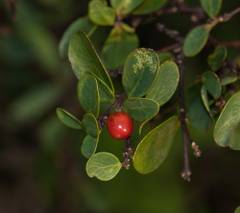
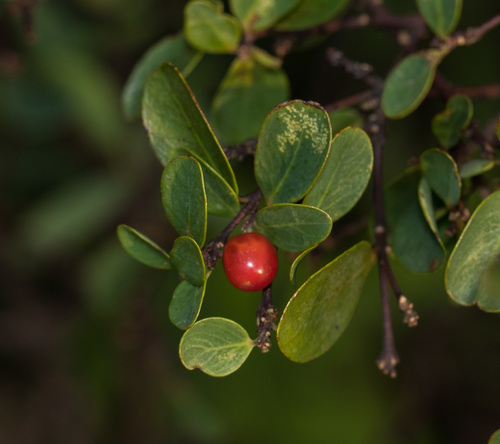
Wikstroemia is a genus of about 70 species of shrubs and small trees in the family Thymelaeaceae, distributed across eastern and southeastern Asia, the Pacific Islands including Hawaii, and parts of Australia. Plants range from low, wiry coastal shrubs under 1 m (3 ft) to upright forms reaching 3-4 m (10-13 ft), with slender, tough-barked stems and simple, opposite or alternate green leaves. The bark is fibrous and strong, and several species have long supplied fibre for paper and cordage. Small tubular flowers, usually yellow to greenish-yellow and sometimes white, are clustered at the stem tips and are followed by fleshy red or orange one-seeded fruits. Many species flower over a long warm season, and the bright fruits are eaten and spread by birds. The genus contains daphnane and related diterpenes, making the bark, leaves, and fruit poisonous to people and animals, and some species were used traditionally as fish poisons. Most grow in open forest, scrub, and coastal sites on free-draining soils, and the coastal kinds tolerate salt and drought. Cold sensitivity confines the genus to subtropical and tropical climates, where habit ranges from compact and mounding to erect and shrubby.
Native Range
The genus ranges across China, Japan, the Korean Peninsula, Southeast Asia, the Malay Archipelago, the Pacific Islands including the Hawaiian Islands, and northern and eastern Australia. Species grow in open forest, scrub, grassland, and on coastal cliffs and dunes. The Hawaiian species, known as akia, are characteristic shrubs of dry coastal and lowland sites.Suggested Uses
Coastal species are used in seaside, dry, and native gardens and for low informal hedging in frost-free regions. The fibrous bark has long been used for paper, cordage, and cloth in Asia and the Pacific. Bird-friendly plantings make use of the fleshy fruit.How to Identify
Appearance
Size & Dimensions
Height1' - 13'
Width/Spread1'6" - 6'6"
Bloom Information
Many species flower over a long period from spring into summer or autumn, and tropical kinds can carry some flowers most of the year. The small tubular flowers open in clusters at the shoot tips. Bright red to orange fruits follow and often overlap with later flowers.
Detailed Descriptions
Flower Description
yellow to greenish-yellow, sometimes whiteFoliage Description
greenGrowing Conditions
Sun Requirements
Requires 4-8 hours of direct sunlight daily
• Full Sun: 6+ hours of direct sunlight
• Partial Shade: 3-6 hours of direct sunlight
• Full Shade: Less than 3 hours of direct sunlight
Care & Maintenance
Care Guide
Plants grow in full sun to light shade on free-draining sandy or loamy soils, including poor and rocky ground. Coastal species tolerate salt wind and drought once established, while forest species prefer steadier moisture. Drainage matters in all cases, as wet, heavy soils bring on root rot. The genus is frost-tender and is grown outdoors only in subtropical and tropical zones, or under glass elsewhere. All parts are poisonous if eaten, and the sap can irritate skin. Pests are few, though scale and mealybugs occur on sheltered plants.Pruning
Light pruning after flowering or fruiting shapes the plant and keeps it dense. Older shrubs are renewed by removing a few of the oldest stems at the base. Plants resprout from semi-hardwood, so moderate cutting back is tolerated.Container Growing
Suitable for container growing
Minimum container size: 5 gallons