Whipplea, Genus, modesta, Species,
- Genus & species
modesty
Pacific Northwest and California, USA
Overview
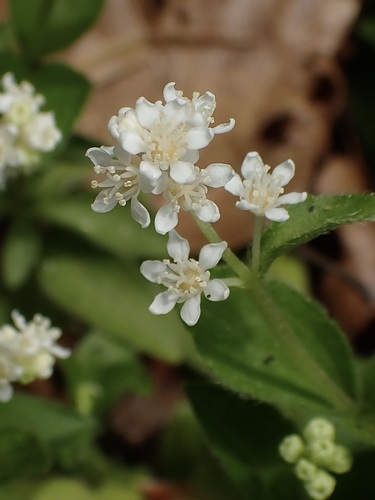
Whipplea modesta is a low, trailing evergreen subshrub forming mats 2-4 inches (5-10 cm) tall, with slender stems reaching 12-32 inches (30-80 cm) long that root where they touch the soil. Leaves are opposite, ovate to elliptic, 0.4-1 inch (1-2.5 cm) long, with a few shallow teeth along the margins and a rough surface from short stiff hairs. White flowers about 0.2 inch (5 mm) across, each with 5-6 petals, are grouped in rounded terminal clusters of 4-10 from April to June. The fruit is a small dry capsule that splits into segments at maturity. Stems are reddish-brown and woody at the base and herbaceous toward the tips. Growth is low and spreading rather than upright, and a single plant can cover 12-24 inches (30-60 cm) of ground within 2-3 seasons. In deep shade flowering is reduced and stems become sparse. It is the sole species in the genus Whipplea.
Native Range
Native to the Pacific coast of North America from western Washington south through Oregon to central California. Grows in coniferous and mixed-evergreen forests, on shaded banks and forest floors, from sea level to about 4,000 feet (1,200 m).Suggested Uses
Used as a shaded groundcover under trees and along banks, spaced 12-18 inches (30-45 cm) apart for cover within 2-3 seasons. Suited to woodland and native plant gardens in coastal climates. Grows poorly in full sun or hot, dry interior sites.How to Identify
Appearance
Size & Dimensions
Height2" - 4"
Width/Spread1' - 2'
Bloom Information
Flowers from April to June across most of its range, beginning earlier at low coastal elevations and later at higher inland sites. Individual clusters remain open 2-3 weeks, and the overall flowering period for a colony spans about 4-6 weeks. Flowering decreases in deep shade.
Detailed Descriptions
Foliage Description
greenGrowing Conditions
Sun Requirements
Tolerates up to 4 hours of direct sunlight daily
• Full Sun: 6+ hours of direct sunlight
• Partial Shade: 3-6 hours of direct sunlight
• Full Shade: Less than 3 hours of direct sunlight
Care & Maintenance
Care Guide
Grows in partial to full shade in moist, humus-rich, well-drained soil. Water during the first growing season to establish; once rooted at the nodes it tolerates summer dryness in coastal climates but declines in prolonged drought at hot interior sites. Acidic forest soils with a surface layer of leaf litter suit it, while soils that stay waterlogged cause stem rot. Few insect pests affect it. Stems that root at the nodes can be separated in spring to start new plants. It spreads slowly and needs no regular feeding.Pruning
Trim trailing stems in spring to contain spread or to remove winter-damaged growth. Cutting back leggy stems encourages branching from the base. No routine pruning is needed for plant health.Pruning Schedule
Prune: March–April
early spring
Container Growing
Suitable for container growing
Minimum container size: 2 gallons