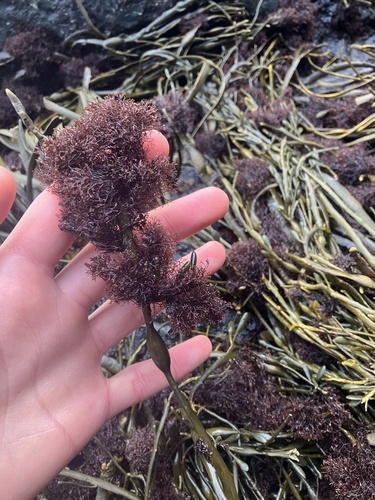
Vertebrata, Genus, lanosa, Species,
- Genus & species
wrack siphon weed
North Atlantic coasts of Europe and North America
Overview
Vertebrata lanosa is a small marine red alga that grows as dense reddish-brown to purplish tufts 0.8-3 inches (2-7 cm) across on the intertidal shores of the North Atlantic. It is almost always attached to the knotted wrack Ascophyllum nodosum, and less often to other brown seaweeds, anchoring into the host by rhizoids rather than living free. The thallus is built from slender, repeatedly branched filaments made of tiers of elongated cells, the siphon-like construction that gives the group its name, forming rounded cushiony balls. Each filament is only a fraction of a millimeter thick, and the whole tuft has a woolly to wiry texture. Reproduction is by spores released from specialized structures rather than by seeds or flowers, following the three-phase life cycle typical of red algae. The alga is a hemiparasite, drawing some nutrients from its wrack host while also photosynthesizing. It occurs on the middle and upper shore wherever knotted wrack grows, exposed at low tide and submerged at high tide. Because it depends on a living host, it is restricted to the same wave-sheltered rocky coasts as Ascophyllum and is absent from open sand or mud.
Native Range
Vertebrata lanosa is native to the rocky intertidal shores of the North Atlantic, on both the European coast from Scandinavia to Portugal and the North American coast from the Arctic to the northeastern United States. It grows only where its host seaweed Ascophyllum nodosum is established.Suggested Uses
Vertebrata lanosa is not used in cultivation. It is studied in marine biology and shore ecology as an example of a red alga that lives attached to a larger seaweed. On the shore it forms part of the intertidal community of the North Atlantic.How to Identify
Appearance
Size & Dimensions
Height1" - 3"
Width/Spread1" - 3"
Bloom Information
This alga does not flower. It reproduces by spores through much of the year, with the alternating life-cycle phases typical of red algae forming reproductive structures along the filaments.