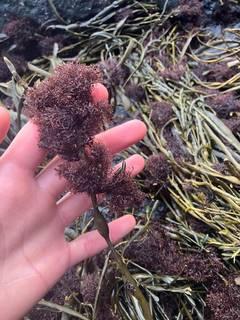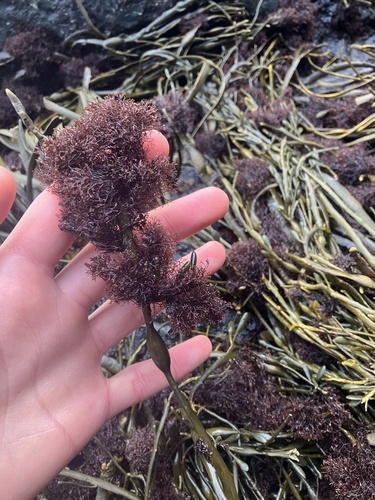
Vertebrata, Genus, spp., Multiple species,
- Genus
- Multiple species
Cold-temperate and boreal rocky shores of the North Atlantic, with further species in the North Pacific, Arctic, Mediterranean, and southern Australasia
WaterHigh
Overview
Vertebrata is a genus of marine red algae in the family Rhodomelaceae, holding roughly 30 accepted species across cold-temperate and boreal shores. Thalli are filamentous and tufted, 0.4-6 inches (1-15 cm) tall, ranging from dark red through purple-black to brownish-black when wet and drying to near black. Construction is polysiphonous: each segment of the axis consists of a central axial cell surrounded by a whorl of four to twenty pericentral cells of equal length, which gives the axis a jointed appearance under magnification and is the source of the genus name. Branching is alternate to irregular and arises from a single dome-shaped apical cell at each tip. Attachment is by unicellular rhizoids or a small discoid holdfast. The life history is triphasic, with free-living gametophytes and tetrasporophytes of matching form plus a carposporophyte retained on the female thallus; tetrasporangia form in spiral series within the outer segments and cystocarps are urn-shaped, 0.01-0.03 inch (0.3-0.8 mm) across. Species limits within Vertebrata rest largely on molecular data, and many members sat in Polysiphonia until sequence work moved them, so separating species in the field calls for counting pericentral cells under a microscope. V. lanosa grows only on the wracks Ascophyllum nodosum and Fucus vesiculosus, sending rhizoids into host tissue.
Native Range
Vertebrata occurs on rocky shores throughout the North Atlantic, from the Arctic coasts of Norway, Iceland, and Greenland south to Portugal on the European side and to North Carolina on the North American side. Further species occur in the North Pacific, the Mediterranean, and around southern Australia and New Zealand. Populations sit in the mid to lower intertidal and shallow subtidal, to depths of about 65 feet (20 m).Suggested Uses
Vertebrata appears in seaweed reference collections, intertidal ecology teaching sets, and herbarium pressings used in algal identification courses. V. lanosa is a common subject in studies of epiphyte and host relationships on rocky shores. The genus is not grown in gardens and is not harvested for food.How to Identify
Appearance
Size & Dimensions
Height6"
Growing Conditions
Water & Climate
Water Needs