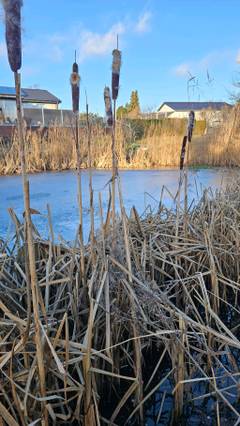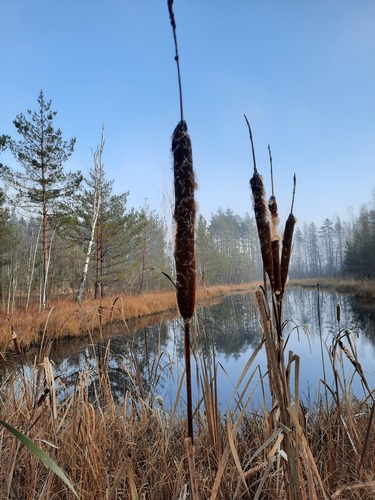
Typha, Genus, latifolia, Species,
- Genus & species
common cat-tail
Across North America including the Pacific Northwest; marshes, pond margins, lake edges, slow rivers, ditches, and wet disturbed ground
Overview
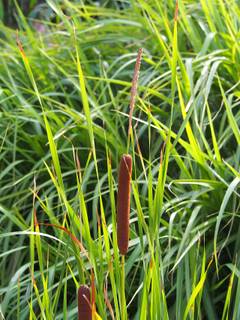
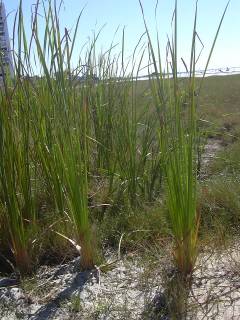
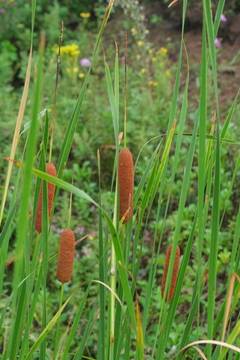
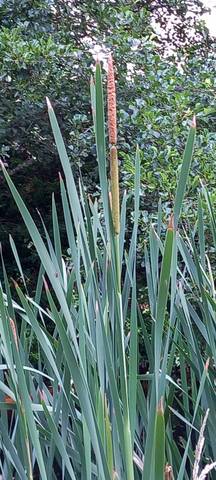
Typha latifolia is a rhizomatous emergent aquatic perennial in the family Typhaceae native to marshes, pond margins, lake edges, slow rivers, ditches, and wet disturbed ground across North America including the Pacific Northwest. The epithet latifolia means broad-leaved and refers to the wide flat leaves. Plants grow 4-9 feet (1.2-2.7 m) tall from stout extensively spreading rhizomes and form dense monodominant stands. Leaves are flat, erect, sword-like, 0.4-1 inch (10-25 mm) wide, and grayish-green; the leaves of T. angustifolia are 0.1-0.4 inch (3-10 mm) wide by comparison. Each fertile stem bears a single inflorescence consisting of a yellow staminate (male) section at the top and a dense brown cylindrical pistillate (female) spike 4-8 inches (10-20 cm) long by 0.75-1.5 inches (2-4 cm) in diameter directly below it. In T. latifolia the male and female sections touch or are separated by only a very small gap, while in T. angustifolia a distinct stretch of bare stem separates the two. The cylindrical brown spike matures in late summer and fall and disintegrates over winter into millions of small seeds attached to white cottony fibers that disperse on wind. Aggressive rhizome spread excludes other emergents within 2-3 seasons in suitable shallow water. Non-toxic; rhizomes and young shoots are starch-rich and have an Indigenous food-use history across North America.
Native Range
Typha latifolia is native across North America including the Pacific Northwest. It grows in marshes, pond margins, lake edges, slow rivers, ditches, and wet disturbed ground in saturated mud or 0-18 inches (0-45 cm) of standing water.Suggested Uses
Used as a dominant emergent in large-scale Pacific Northwest wetland restoration, stormwater treatment marshes, and wildlife pond margins at 24-36 inch (60-90 cm) spacing. Dense stands provide nesting and cover habitat for red-winged blackbirds, marsh wrens, bitterns, and muskrats. Rhizomes and young shoots have Indigenous food-use history across North America. Spikes are used in dried arrangements when cut before disintegration.How to Identify
Appearance
Size & Dimensions
Height4' - 9'
Width/Spread2' - 4'
Bloom Information
Yellow staminate (male) flowers at the top of the spike release pollen May through July and then wither. The pistillate (female) cylindrical spike below develops through summer and ripens dark chocolate brown September through November. Bloom duration averages 8 weeks. The mature spike disintegrates from late fall through winter, releasing small seeds attached to white cottony fibers that disperse on wind. Wind-pollinated.
Detailed Descriptions
Flower Description
yellow staminate (male) section above and dense brown cylindrical pistillate (female) spike 4-8 inches (10-20 cm) long below on a single stout stem; male and female sections continuous with little or no gap; May-July pollen, ripens September-NovemberFoliage Description
grayish-green; flat sword-like blades 0.4-1 inch (10-25 mm) wide; wider than Typha angustifolia (0.1-0.4 inch / 3-10 mm)Growing Conditions
Sun Requirements
Requires 6-12 hours of direct sunlight daily
• Full Sun: 6+ hours of direct sunlight
• Partial Shade: 3-6 hours of direct sunlight
• Full Shade: Less than 3 hours of direct sunlight
Care & Maintenance
Care Guide
Plant in full sun in wet to standing-water conditions with a pH of 5.5-8.0; tolerated soil types include clay, silt, and loam. Suited to saturated mud or 0-18 inches (0-45 cm) of standing water. Plugs or rhizome divisions are set at 24-36 inch (60-90 cm) spacing in shallow margins. Establishment takes 2-3 growing seasons. Spreads aggressively by rhizome and forms monodominant stands within 2-3 seasons that exclude other emergent species; this rules out small ponds and mixed plantings without active rhizome management. Annual rhizome severing at the desired perimeter limits lateral expansion.Pruning
No routine pruning is needed. Old brown spikes and dead stems can be cut to ground level in early spring (March) before new growth emerges. Standing dead stems function as winter cover and nesting structure for marsh birds and are typically left in place through the cold season. Annual rhizome severing at a defined perimeter limits lateral spread.Pruning Schedule
Prune: March
early spring