Turritis, Genus, glabra, Species,
- Genus & species
tower mustard
Circumboreal (North America, Europe, Asia)
Overview
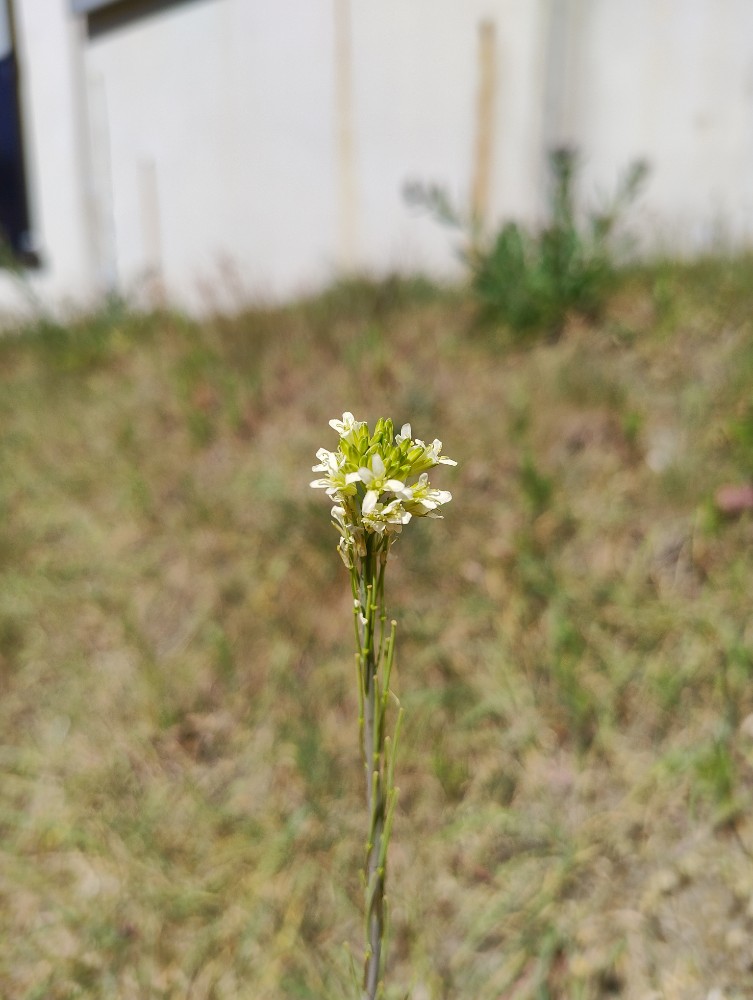
Turritis glabra, formerly classified as Arabis glabra, is a biennial or short-lived perennial herb in the mustard family. In its first year it forms a basal rosette of gray-green, toothed leaves 2-5 inches (5-13 cm) long covered with branched hairs. In the second year it sends up a single erect, unbranched stem 2-5 feet (60-150 cm) tall. The stem leaves are smooth, hairless, and waxy blue-green, clasping the stem with arrow-shaped bases, in contrast to the hairy rosette leaves below. Small flowers 0.2-0.3 inch (5-8 mm) wide with four petals, pale yellow to creamy white, open in a narrow elongating cluster at the stem tip. Flowering proceeds from the bottom upward over several weeks in late spring and summer. The fruits are slender erect pods (siliques) 2-4 inches (5-10 cm) long that press close to the stem, giving the flowering spike a tall, columnar outline. The plant grows in dry, open ground, rocky slopes, woodland edges, and disturbed sites. It is short-lived, dying after setting seed, and self-sows where soil is bare. On rich or moist soils it grows lank and topples more readily.
Native Range
Turritis glabra has a circumboreal distribution, native across North America, Europe, and Asia. In North America it occurs through much of Canada and the United States in dry open woods, prairies, rocky slopes, and roadsides.Suggested Uses
Turritis glabra is used in native plant gardens, meadow and prairie plantings, and naturalized dry banks. Its vertical form suits the back of informal borders and wildflower areas. It supports early-season pollinators and serves as a larval host for some white and orangetip butterflies.How to Identify
Appearance
Size & Dimensions
Height2' - 5'
Width/Spread6" - 1'
Bloom Information
Pale yellow to creamy white flowers open from late spring into summer (May-July), beginning at the base of the terminal cluster and progressing upward over several weeks. Each flower is short-lived, but the elongating cluster keeps the plant in bloom for four to six weeks. Erect seed pods follow and ripen by late summer.
Detailed Descriptions
Flower Description
pale yellow to creamy whiteFoliage Description
gray-green rosette leaves; waxy blue-green stem leavesGrowing Conditions
Sun Requirements
Requires 6-10 hours of direct sunlight daily
• Full Sun: 6+ hours of direct sunlight
• Partial Shade: 3-6 hours of direct sunlight
• Full Shade: Less than 3 hours of direct sunlight