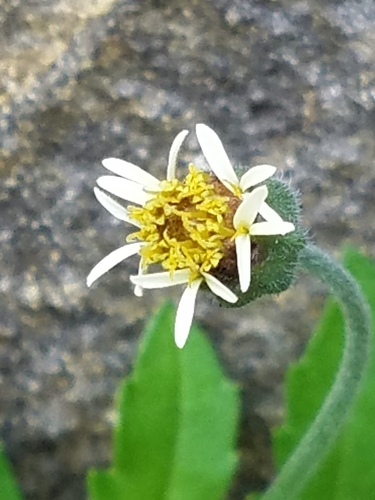
Tridax, Genus, procumbens, Species,
- Genus & species
tridax daisy
Overview
Tridax procumbens is a low, sprawling herb in the daisy family, reaching 6-20 inches (15-50 cm) tall with stems that root where they touch the ground. It grows as a short-lived perennial in frost-free climates and as an annual where winters are cold. The opposite leaves are 1-3 inches (2.5-7.5 cm) long, ovate to lance-shaped, coarsely toothed, and covered in stiff hairs. Solitary flower heads 0.4-0.6 inch (1-1.5 cm) across sit on slender stalks 4-12 inches (10-30 cm) long, each head carrying three to six cream to pale-yellow ray florets, notched at the tip, around a yellow disk. The seeds are small dark achenes topped with a feathery pappus that carries them on the wind, and a single plant can release several thousand. Tridax procumbens withstands heat, drought, and compacted or disturbed soil, colonizing roadsides, lawns, and field margins. It is listed as a noxious weed in several countries and spreads quickly once established. The plant has a long record of use in traditional medicine across its naturalized range.
Native Range
Tridax procumbens is native to tropical Mexico and Central America. It has naturalized across the tropics and subtropics of the Americas, Africa, Asia, and Australia, where it is treated as a weed.Suggested Uses
Rarely planted on purpose, it appears in informal ground cover, pollinator plantings, and ethnobotanical or teaching collections. Bees and small butterflies visit the open flower heads. Its tendency to self-seed and root at the nodes suits contained beds where its spread can be limited.How to Identify
Appearance
Size & Dimensions
Height6" - 1'8"
Width/Spread1' - 2'
Bloom Information
In frost-free climates flowering occurs throughout the year, with the heaviest bloom during warm, moist months. Where winters are cold, flowering runs from late spring to autumn. Each head opens for several days before drying into a seed ball.
Detailed Descriptions
Flower Description
cream to pale yellow with a yellow centerFoliage Description
greenGrowing Conditions
Sun Requirements
Requires 6-12 hours of direct sunlight daily
• Full Sun: 6+ hours of direct sunlight
• Partial Shade: 3-6 hours of direct sunlight
• Full Shade: Less than 3 hours of direct sunlight
Care & Maintenance
Care Guide
Grow in full sun and almost any well-drained soil, including poor, sandy, and compacted ground. Established plants are drought tolerant and need no supplemental water in most climates. Overwatering and rich soil encourage soft, sprawling growth. The plant self-seeds prolifically and can overtake open ground, so spent heads are removed before the seed disperses where spread is unwanted. It withstands mowing and regrows from rooted stem nodes. No fertilizer is needed.Pruning
Trimming is limited to cutting back sprawling stems and removing flower heads to curb self-seeding. Mowing or shearing the plant to the ground prompts dense regrowth from the rooting nodes. Taking off seed heads before they dry is the main means of limiting spread.Container Growing
Suitable for container growing