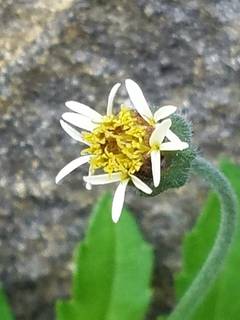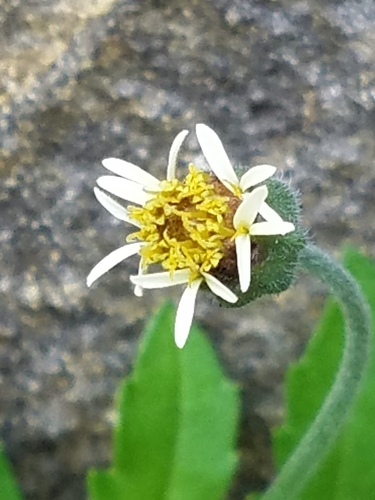
Tridax, Genus, spp., Multiple species,
- Genus
- Multiple species
coat buttons
Overview
Tridax is a genus of about thirty daisy-family herbs, Asteraceae, native to the warmer parts of the Americas and centred in Mexico. The widely spread coat buttons, T. procumbens, is a low, sprawling to ascending herb 6-20 inches (15-50 cm) tall, with hairy, toothed, roughly arrow-shaped leaves on trailing stems that root at the nodes. Each flower head is held on a long stalk and carries a ring of a few short, creamy-white to pale yellow ray florets, each tipped with three small teeth, around a yellow central disc. The heads close into a fluffy ball of parachute-tipped seeds that scatter on the wind. T. procumbens has spread through the tropics and subtropics worldwide as a weed of crops, lawns, and roadsides, and it is listed as a federal noxious weed in the United States. It seeds heavily and grows year-round in frost-free climates, which underlies both its persistence as a weed and its use in folk medicine across its range. The genus is frost-tender and dies back or dies off where winters are cold. Most species are far less weedy than the well-known T. procumbens.
Native Range
Native to tropical and subtropical America, especially Mexico and Central America, with T. procumbens now spread as a weed through the tropics of Africa, Asia, and Australia.Suggested Uses
Most species have little ornamental use, and T. procumbens is treated as a weed rather than a garden plant; it is gathered in some regions for traditional medicine and as fodder. A few less weedy species are grown in dry, warm-climate native plantings.How to Identify
Appearance
Size & Dimensions
Height6" - 1'8"
Width/Spread1' - 2'
Bloom Information
In frost-free climates Tridax flowers more or less year-round, with peaks in the warm, wet season. The long-stalked heads open over many weeks and are followed quickly by wind-borne seed. Where winters are cold, flowering runs from summer to autumn.
Detailed Descriptions
Flower Description
creamy-white to pale yellow with a yellow discFoliage Description
greenGrowing Conditions
Sun Requirements
Requires 6-12 hours of direct sunlight daily
• Full Sun: 6+ hours of direct sunlight
• Partial Shade: 3-6 hours of direct sunlight
• Full Shade: Less than 3 hours of direct sunlight