Tigridia, Genus, spp., Multiple species,
- Genus
- Multiple species
tiger flower
Overview
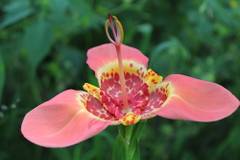
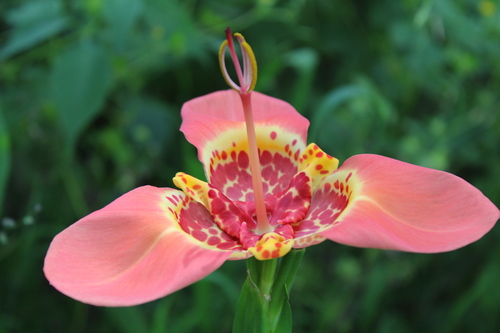
Tigridia is a genus of roughly 35 to 55 cormous perennials in the iris family, Iridaceae, native to the Americas from Mexico and Guatemala south through the Andes to Chile. Plants grow from a tunicated corm and produce a fan of pleated, sword-shaped leaves 8-18 inches (20-45 cm) long. Flowering stems reach 12-24 inches (30-60 cm). Each flower is built on a triangular plan: three broad outer tepals form the showy outline while three much smaller inner tepals stand at the centre, and the cupped base is marked with contrasting spots and blotches. Colours range across red, orange, yellow, pink, and white, often with a spotted throat in a second colour, and a single bloom spans 4-6 inches (10-15 cm). The species most often grown, T. pavonia, has been cultivated since pre-Columbian times in Mexico, where its corm was also used as food. Individual flowers open in the morning and collapse by evening, but a stem carries several buds that open in succession over a few weeks of summer. The corms are frost-tender and rot in cold wet soil, so in cool climates they are lifted and stored over winter.
Native Range
Native to the Americas, with the centre of diversity in Mexico and Guatemala and further species ranging south through the highlands of Central America and the Andes to Peru and Chile.Suggested Uses
Planted in summer borders, gravel beds, and containers where the daily succession of flowers can be seen at close range. In cold regions it is grown as a lifted summer bulb in the manner of gladiolus.How to Identify
Appearance
Size & Dimensions
Height1' - 2'
Width/Spread4" - 6"
Bloom Information
Flowering occurs in summer, with each flower opening in the morning and wilting the same evening. A succession of buds on each stem extends the display over four to six weeks. Corms started in spring flower roughly 10 to 14 weeks later.
Detailed Descriptions
Flower Description
red, orange, yellow, pink, or white with a spotted centreFoliage Description
greenGrowing Conditions
Sun Requirements
Requires 6-12 hours of direct sunlight daily
• Full Sun: 6+ hours of direct sunlight
• Partial Shade: 3-6 hours of direct sunlight
• Full Shade: Less than 3 hours of direct sunlight
Care & Maintenance
Care Guide
Corms are planted in spring once the soil has warmed, set 3-4 inches (8-10 cm) deep in full sun and free-draining soil with a pH near 6.0 to 7.5. Even moisture during summer growth supports flowering, while sharp drainage prevents the corm from rotting. In zones 8 and warmer the corms can remain in the ground; in colder areas they are lifted after the foliage dies down and stored dry over winter. Spider mites and corm rot are the main problems under poor air movement or wet cold soil. Clumps can be divided when lifted, separating offset cormels for increase.Pruning
No pruning is needed. Faded flowers drop on their own, and the foliage is left to die back so the corm can recharge before lifting or dormancy.Container Growing
Suitable for container growing
Minimum container size: 2 gallons