Image 1 of 13
1 / 13
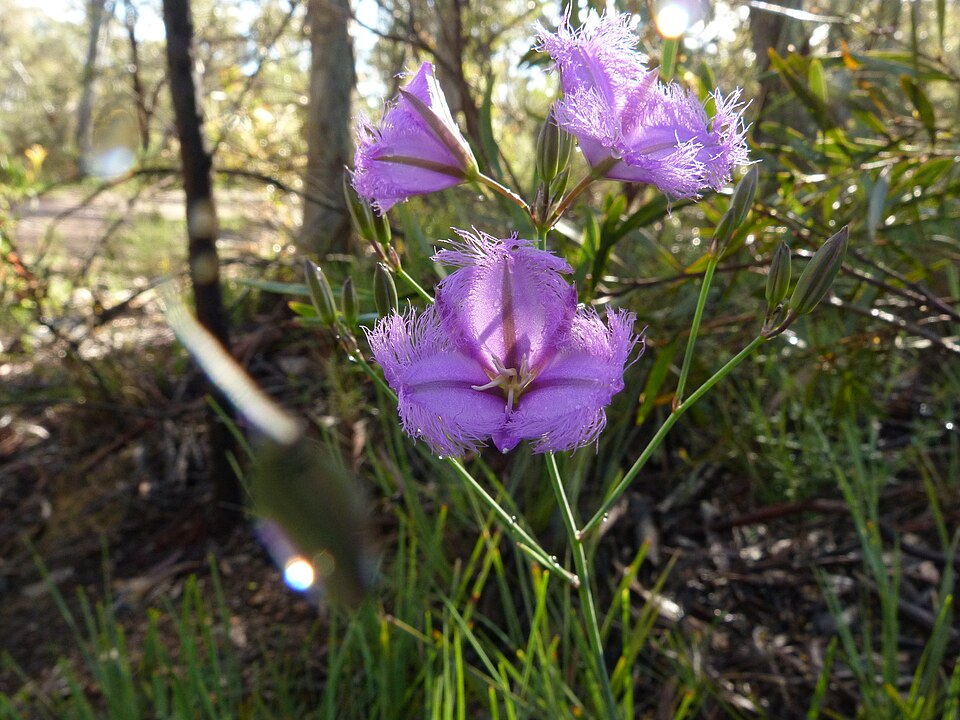
© Donald Hobern from Canberra, Australia, some rights reserved (CC-BY) · Wikimedia Commons
Thysanotus, Genus, tuberosus, Species,
- Genus & species
common fringe-lily
Overview
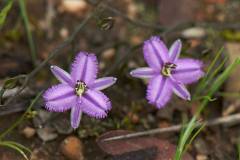
Thysanotus tuberosus is a tufted perennial herb growing from fleshy tuberous roots, reaching 20-45 cm (8-18 in) tall. The narrow, grass-like basal leaves are channelled and often wither by flowering time. Slender erect to branched flowering stems carry violet to purple flowers 2-3 cm (0.8-1.2 in) across, each with three petals whose margins are deeply fringed into slender threads, the feature that names the fringe-lilies. Six yellow anthers cluster at the flower centre. Each flower opens for a single morning and closes by afternoon, with new flowers opening in succession over several weeks. The fruit is a small capsule holding black seeds. The plant grows in grassland, open eucalypt woodland, and heath in well-drained sandy or loam soils, dying back to the tubers during dry summer dormancy. Limitation: the one-day flowers and summer dormancy mean the plant is conspicuous only briefly, and the deep tubers make established clumps hard to transplant.
Native Range
Eastern and southern Australia, including Queensland, New South Wales, the Australian Capital Territory, Victoria, Tasmania, and South Australia. It grows in grassland, grassy woodland, and heath.Suggested Uses
Grown in native grassland gardens, rockeries, and containers, and in meadow-style plantings with other seasonal geophytes. It suits well-drained sunny sites with a dry summer.How to Identify
Appearance
Size & Dimensions
Height8" - 1'6"
Width/Spread6" - 1'
Bloom Information
Detailed Descriptions
Flower Description
violet to purpleFoliage Description
greenGrowing Conditions
Sun Requirements
Requires 5-9 hours of direct sunlight daily
• Full Sun: 6+ hours of direct sunlight
• Partial Shade: 3-6 hours of direct sunlight
• Full Shade: Less than 3 hours of direct sunlight
Care & Maintenance
Care Guide
Grows in well-drained sandy or loam soils in full sun to light shade. It needs a dry summer dormancy and tolerates extended drought once the tubers are established. Water from autumn through spring during active growth, then reduce water as the leaves die back. Plants are hardy to frost within their native range. Waterlogging and root disturbance damage the tubers. The species is grown from seed or by careful division of the tubers during dormancy.Pruning
No pruning is needed. The leaves and flowering stems die back to the tubers over summer and regrow after autumn rains. Withered stems can be removed once the plant is dormant.Container Growing
Suitable for container growing
Minimum container size: 1 gallons