Image 1 of 2
1 / 2
© Donald Hobern from Canberra, Australia, some rights reserved (CC-BY) · Wikimedia Commons
Thysanotus, Genus, spp., Multiple species,
- Genus
- Multiple species
fringe lily
Overview
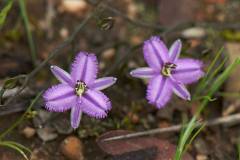
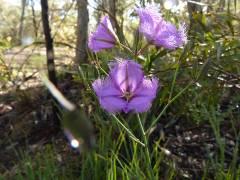
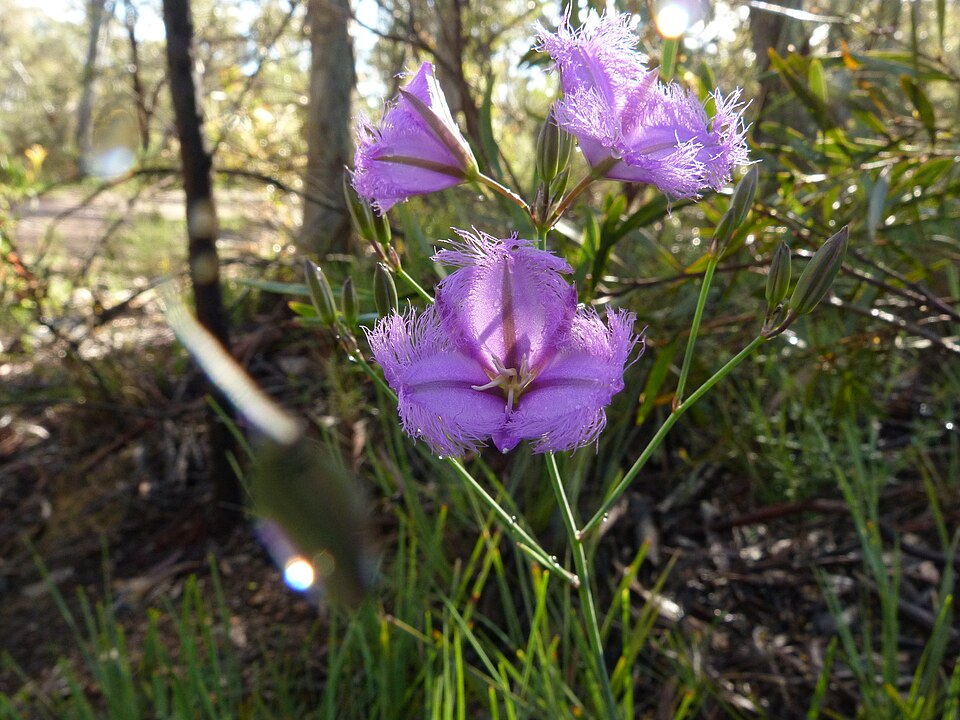
Thysanotus is a genus of about 50 species of herbaceous perennials in the family Asparagaceae, the majority restricted to Australia with a few species reaching New Guinea and southern China. Plants grow from short rhizomes or small tubers and reach 4-24 inches (10-60 cm) tall. Leaves are grass-like and round in cross-section, and in several species reduce to scales while green twining stems take over photosynthesis. The flowers give the genus its common name, fringe lily: three of the six tepals carry a fringe of thread-like divisions along their margins, while the other three remain plain. Colours span violet, purple, pink, and occasionally white, 0.4-1.2 inches (1-3 cm) across. Each flower opens for a single day, usually through the morning, and a plant carries a succession over several weeks. Species such as T. multiflorus form dense tufts of many stems, while T. patersonii climbs by twining through surrounding vegetation. Most grow in sandy, free-draining soils of heath and open sclerophyll woodland. The genus establishes slowly from seed and does not transplant well once settled, which limits its use in regular border rotation.
Native Range
The genus is centred in Australia, where it occurs in every state and is especially diverse in the south-west of Western Australia. A small number of species extend north through New Guinea to southern China and parts of South-East Asia.Suggested Uses
Grown in native and water-wise gardens, rockeries, and sandy coastal plantings within its climate range. Suited to containers where drainage and dormancy can be controlled. The twining species can be threaded through low shrubs for support.How to Identify
Appearance
Size & Dimensions
Height4" - 2'
Width/Spread4" - 1'
Bloom Information
Flowering runs through spring and into summer across most of the genus, with individual flowers opening for one day and closing by afternoon. A single plant produces flowers in succession over four to eight weeks. Under glass the season shifts with local conditions.
Detailed Descriptions
Flower Description
violet to purple, occasionally whiteFoliage Description
greenGrowing Conditions
Sun Requirements
Requires 6-12 hours of direct sunlight daily
• Full Sun: 6+ hours of direct sunlight
• Partial Shade: 3-6 hours of direct sunlight
• Full Shade: Less than 3 hours of direct sunlight
Care & Maintenance
Care Guide
Most species grow in full sun in sandy, sharply drained soil with a pH from about 5.0 to 7.0. Water is needed during active growth in spring, after which many species tolerate dry summer dormancy. Established plants are drought tolerant and need little supplementary feeding. Seed is the usual means of increase, though germination can be slow and erratic, and some species respond to smoke treatment. Plants form slender roots that do not recover well from being moved, so container culture or an undisturbed position suits them. Frost tolerance is limited, and most species are grown outdoors only in zones 9 to 11.Pruning
No formal pruning is required. Spent flowering stems can be removed once they dry, and foliage that yellows at the onset of dormancy can be cleared. Plants resprout from the rootstock in the following season.Container Growing
Suitable for container growing
Minimum container size: 2 gallons