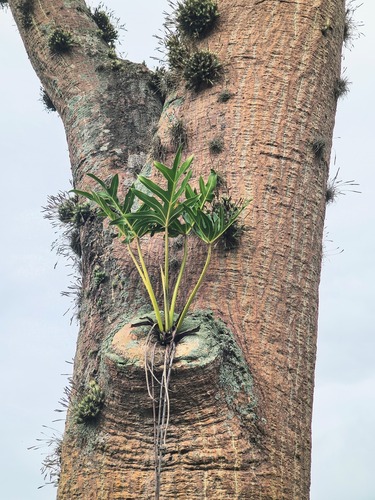
Thaumatophyllum, Genus, spp., Multiple species,
- Genus
- Multiple species
tree philodendrons
Overview
Thaumatophyllum is a small genus of evergreen perennials in the arum family, native to South America and split from Philodendron. Plants form large rosettes of long-stalked leaves on a thick, sometimes self-supporting stem that can become trunk-like with age, reaching 4-15 feet (1.2-4.5 m) tall and as wide. The leaves are large and leathery, 1-3 feet (30-90 cm) long, deeply cut into many lobes or pinnae, glossy deep green, held on stout petioles; older stems show prominent leaf scars and produce aerial roots. As the plant matures, lower leaves drop to expose the stem. Like other aroids, the flowers form a pale spathe wrapped around a fleshy spadix, produced on mature plants and giving off warmth as they open, though plants are grown for foliage rather than bloom. All parts contain calcium oxalate crystals that cause burning and swelling of the mouth and throat if chewed and can irritate skin. T. bipinnatifidum, long sold as tree philodendron or Philodendron selloum, is the species most often grown. Plants are frost-tender and slow- to moderate-growing, living many years.
Native Range
The genus Thaumatophyllum is native to South America, chiefly Brazil, Paraguay, Bolivia, and northern Argentina. Plants grow in tropical and subtropical forest, scrub, and rocky ground, often in bright, humid clearings and on slopes. T. bipinnatifidum ranges through southeastern Brazil and neighboring countries.Suggested Uses
Grown as a foliage houseplant, conservatory specimen, and, in frost-free climates, a landscape plant for tropical-style borders and courtyards, given 4-8 feet (1.2-2.4 m) of space. Used where a large, bold-leaved evergreen is wanted indoors or in shade. Young plants are grown in containers and potted on as they enlarge.How to Identify
Appearance
Size & Dimensions
Height4' - 15'
Width/Spread4' - 10'
Bloom Information
Flowers are produced only on mature plants and are uncommon in cultivation. The arum-type inflorescence has a cream to white spathe around a spadix and gives off warmth and scent as it opens, usually in late spring or summer. The genus is grown for its foliage rather than its flowers. Each inflorescence lasts only a day or two.
Detailed Descriptions
Flower Description
cream to white spatheFoliage Description
glossy deep greenGrowing Conditions
Sun Requirements
Requires 2-6 hours of direct sunlight daily
• Full Sun: 6+ hours of direct sunlight
• Partial Shade: 3-6 hours of direct sunlight
• Full Shade: Less than 3 hours of direct sunlight
Care & Maintenance
Care Guide
Grows in bright, indirect light to part shade in moist, fertile, well-drained soil rich in organic matter, with leaf size larger in good light and humidity. Plants are watered when the surface dries and are kept warm above 55°F (13°C), as they are damaged by frost. As lower leaves age and drop, the lengthening stem may need support or can be allowed to lean. Spider mites and mealybugs occur in dry indoor air. The wide leaf spread calls for ample room. Outdoors the genus is grown only in frost-free climates, where it forms broad clumps.Pruning
Old, yellowing lower leaves are removed at the petiole base as they fade to keep the plant tidy and expose the stem. No structural pruning is needed, though the growing tip can be cut to limit height, after which side shoots may form. Aerial roots can be left, tucked into the pot, or trimmed without harming the plant.Container Growing
Suitable for container growing
Minimum container size: 5 gallons
