Terminalia, Genus, catappa, Species,
- Genus & species
sea almond
Tropical Asia, northern Australia, and the Pacific (coastal lowlands)
Overview
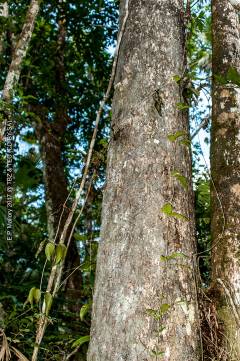
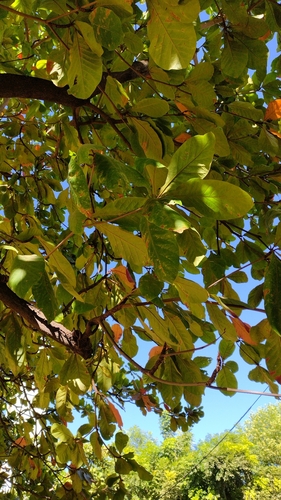
Terminalia catappa is a large tropical tree in the family Combretaceae, reaching 50-80 feet (15-25 m) tall with a habit of horizontal branches arranged in tiers, producing a broad, pagoda-like crown spreading 30-50 feet (9-15 m). The leaves are obovate and leathery, 6-14 inches (15-35 cm) long, clustered in rosettes at branch tips, and turn red, yellow, and copper before dropping during dry or cool periods, often twice a year. Small greenish-white flowers are borne on slender spikes 4-6 inches (10-15 cm) long, the male and bisexual flowers on the same spike. The fruit is a flattened, two-ridged drupe 2-3 inches (5-7 cm) long that ripens from green to red or purple, with a fibrous husk surrounding a single edible kernel; the corky fruit floats and is dispersed by water. Terminalia catappa tolerates salt spray and sandy soils, which suits it to coastal planting, and casts dense shade beneath its layered canopy. Limitations include frost sensitivity below about 30F (-1C), shallow roots that lift pavement, and heavy leaf and fruit drop that creates litter.
Native Range
Terminalia catappa is native to the coasts and lowlands of tropical Asia, from India and Southeast Asia through Malesia to northern Australia and the Pacific Islands. It grows naturally on sandy and rocky shorelines just above the high-tide line. It is now widely planted and naturalised throughout the tropics, including the Caribbean, Africa, and tropical America.Suggested Uses
Terminalia catappa is planted as a shade and street tree in tropical parks, along beaches, and in large gardens, spaced 30-50 feet (9-15 m) apart. It is used for coastal stabilisation, and its kernels, leaves, and bark are gathered for food, traditional dyes, and tannins.How to Identify
Appearance
Size & Dimensions
Height50' - 80'
Width/Spread30' - 50'
Bloom Information
Terminalia catappa flowers more or less year-round in wet tropical climates, with peaks tied to the start of rainy seasons. Slender spikes of small greenish-white flowers appear among the terminal leaf rosettes. Fruit follows over the next few months, and trees often carry flowers and ripening fruit at the same time.
Detailed Descriptions
Foliage Description
Glossy green, turning red and yellow before fallGrowing Conditions
Sun Requirements
Requires 6-12 hours of direct sunlight daily
• Full Sun: 6+ hours of direct sunlight
• Partial Shade: 3-6 hours of direct sunlight
• Full Shade: Less than 3 hours of direct sunlight