Terminalia, Genus, spp., Multiple species,
- Genus
- Multiple species
Cluster-leafs
Pantropical (Africa, Asia, Australia, Americas)
Overview
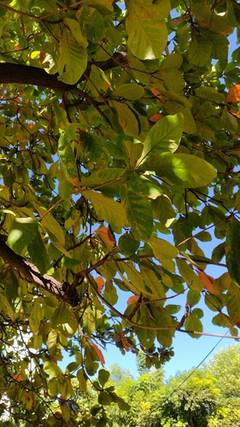
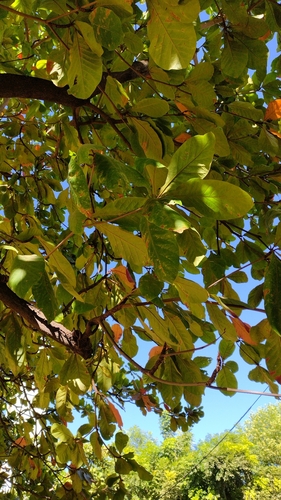
Terminalia is a genus of around 200 species of trees in the family Combretaceae, native to tropical regions worldwide. Most are large trees reaching 30–115 feet (9–35 m) tall, with a single trunk and horizontal branches arranged in tiers, giving a layered, pagoda-like canopy. Leaves are simple, often crowded in rosettes at the branch tips, 3–12 inches (8–30 cm) long and leathery, and in many species turn red, orange, or yellow before dropping in the dry season. Flowers are small, 0.1–0.3 inch (3–8 mm) across, greenish-white to cream, borne in slender spikes, and often unpleasantly scented. Fruit is a flattened, two-winged or fleshy drupe 1–3 inches (2.5–8 cm) long, carried by water or animals. T. catappa produces an edible almond-like seed, while T. chebula and T. arjuna yield tannin-rich fruit and bark used in traditional medicine and dyeing. Most species are frost-tender and restricted to tropical and warm subtropical climates.
Native Range
Native across the tropics of Africa, Asia, Australia, and the Americas, with the greatest concentration of species in Asia and Africa. Grows in coastal forests, savanna, riverbanks, and seasonally dry woodland from sea level to about 5,000 feet (1,500 m). T. catappa occurs along tropical coasts and has naturalized on shorelines beyond its native range.Suggested Uses
Grown as a shade and street tree in tropical parks, avenues, and coastal plantings, spaced 25–40 feet (8–12 m) apart. T. catappa is planted for shade and its edible seed, and T. mantaly is used as a compact ornamental and hedge in frost-free regions. Surface roots and litter limit use near pavement and small gardens.How to Identify
Appearance
Size & Dimensions
Height30' - 115'
Width/Spread25' - 50'
Colors
Bloom Information
Flowering follows the tropical wet and dry cycle rather than fixed months, often at the start of the rains or with new leaf flush. Slender spikes of greenish-white flowers open over 2–4 weeks. In equatorial climates some species flower more than once a year, while seasonally dry regions produce a single flush.
Detailed Descriptions
Flower Description
greenish-white to creamFoliage Description
green, turning red, orange, or yellow before droppingGrowing Conditions
Sun Requirements
Requires 6-12 hours of direct sunlight daily
• Full Sun: 6+ hours of direct sunlight
• Partial Shade: 3-6 hours of direct sunlight
• Full Shade: Less than 3 hours of direct sunlight