Tecomaria capensis
Cape honeysuckle
Overview
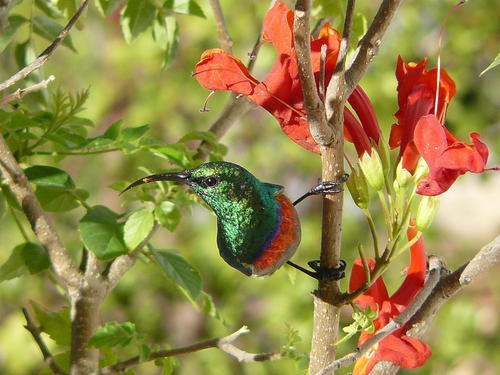
Tecomaria capensis is a scrambling evergreen shrub that grows 6-10 feet (1.8-3 m) tall as a free-standing mound or climbs 12-25 feet (3.7-7.6 m) when supported, sending out long, arching canes. Leaves are pinnately compound, 4-6 inches (10-15 cm) long, with 5-9 glossy dark green, toothed leaflets. Clusters of tubular flowers 1.5-2 inches (4-5 cm) long open at the branch tips, curved and flaring into five lobes, in orange to scarlet and, in named forms, yellow or salmon. Bloom is heaviest in late summer and fall but continues year-round in frost-free climates. Curved seed capsules follow the flowers in warm regions. Growth is fast and dense, and untrained plants sucker and root where canes touch soil, spreading into thickets. Foliage is damaged below about 28F (-2C), and top growth is killed by hard frost, though established roots resprout in zones 8-9.
Native Range
Native to southern Africa, from South Africa's Eastern Cape north through eSwatini and Mozambique into eastern Africa. Grows on forest margins, bushveld, rocky slopes, and coastal scrub, often scrambling over other vegetation.Suggested Uses
Planted as an informal hedge, bank cover, or espalier and trained on fences and trellises in frost-free and near-frost-free regions, spaced 3-5 feet (0.9-1.5 m) apart. The tubular flowers draw hummingbirds, sunbirds, and butterflies. Its suckering, scrambling habit makes it hard to contain in small or formal gardens.How to Identify
Appearance
Size & Dimensions
Height6' - 10'
Width/Spread6' - 10'
Bloom Information
Detailed Descriptions
Flower Description
orange to scarletFoliage Description
dark greenGrowing Conditions
Sun Requirements
Requires 6-12 hours of direct sunlight daily
• Full Sun: 6+ hours of direct sunlight
• Partial Shade: 3-6 hours of direct sunlight
• Full Shade: Less than 3 hours of direct sunlight
Care & Maintenance
Care Guide
Grows in full sun to part shade in well-drained soil and tolerates heat, wind, salt spray, and a range of soils once established. Water regularly through the first season, then occasionally, as established plants are drought-tolerant but flower more with summer moisture. It spreads by suckers and rooting canes and can overrun nearby plants without regular cutting back. Top growth is killed below about 25F (-4C), resprouting from the roots in zones 8-9 and staying evergreen in zones 10-11. Whiteflies, aphids, and scale may appear. Plants are vigorous and long-lived where winters are mild.Pruning
Cut back hard in late winter or early spring to control size and remove frost-damaged wood; the plant resprouts quickly. Shear after the main bloom to shape it as a shrub or hedge. Removing suckers and rooting canes limits its spread.Pruning Schedule
J
F
M
A
M
J
J
A
S
O
N
D
winterearly spring
Container Growing
✓ Suitable for container growing
Minimum container size: 10 gallons