Taraxia, Genus, ovata, Species,
- Genus & species
sun cup
Overview
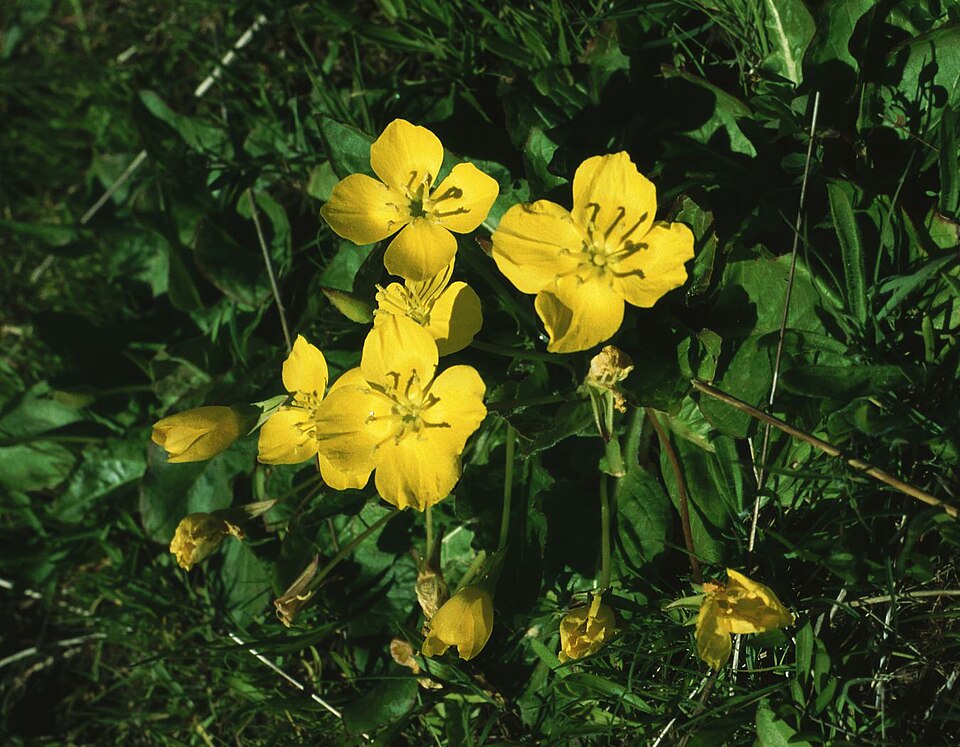
Taraxia ovata is a low, stemless perennial in the evening primrose family, forming a flat basal rosette of leaves pressed close to the ground from a deep taproot. The lance-shaped to oval leaves are 2-6 inches (5-15 cm) long, green, often with a reddish midrib and wavy margins. Bright yellow, four-petaled, cup-shaped flowers about 1-1.5 inches (2.5-4 cm) across sit almost at ground level among the leaves on short stalks, opening in spring. Each flower lasts a day or two, and a rosette produces many in succession. The fruit is a hard, four-angled capsule held near the soil. It grows in coastal grasslands, open clay flats, and grassy slopes of California and southwestern Oregon, on ground that is moist in winter and spring and dry in summer. The plant dies back to the taproot in summer drought, leaving bare ground until the rains return.
Native Range
Taraxia ovata is native to California and southwestern Oregon, where it grows in coastal grasslands, open clay flats, and grassy slopes that are moist in winter and spring.Suggested Uses
Used in native California gardens, grassland restorations, rock gardens, and meadow plantings with a winter-wet, summer-dry cycle. The spring flowers draw native bees. It is sown in fall or planted where summer water can be withheld during dormancy.How to Identify
Appearance
Size & Dimensions
Height2" - 6"
Width/Spread8" - 1'4"
Bloom Information
Bright yellow cup-shaped flowers open in spring, generally February to May. Each flower lasts a day or two, and a rosette opens many over several weeks. Bloom ends as the soil dries in late spring.
Detailed Descriptions
Foliage Description
green with reddish midribGrowing Conditions
Sun Requirements
Requires 6-12 hours of direct sunlight daily
• Full Sun: 6+ hours of direct sunlight
• Partial Shade: 3-6 hours of direct sunlight
• Full Shade: Less than 3 hours of direct sunlight
Care & Maintenance
Care Guide
Grows in full sun in heavy or clay soil that is moist through winter and spring and dry in summer, with a pH near 6.0-7.5. It suits sites with a winter-wet, summer-dry pattern and goes dormant once the soil dries. Summer irrigation can rot the taproot, so it is kept dry during dormancy. No routine feeding is needed. It grows from seed and forms a long taproot that does not transplant well once established.Pruning
No pruning is needed. Spent flower stalks and dried leaves can be removed as the plant goes summer dormant. Leaving capsules to ripen allows self-sowing.Container Growing
Suitable for container growing
Minimum container size: 1 gallons