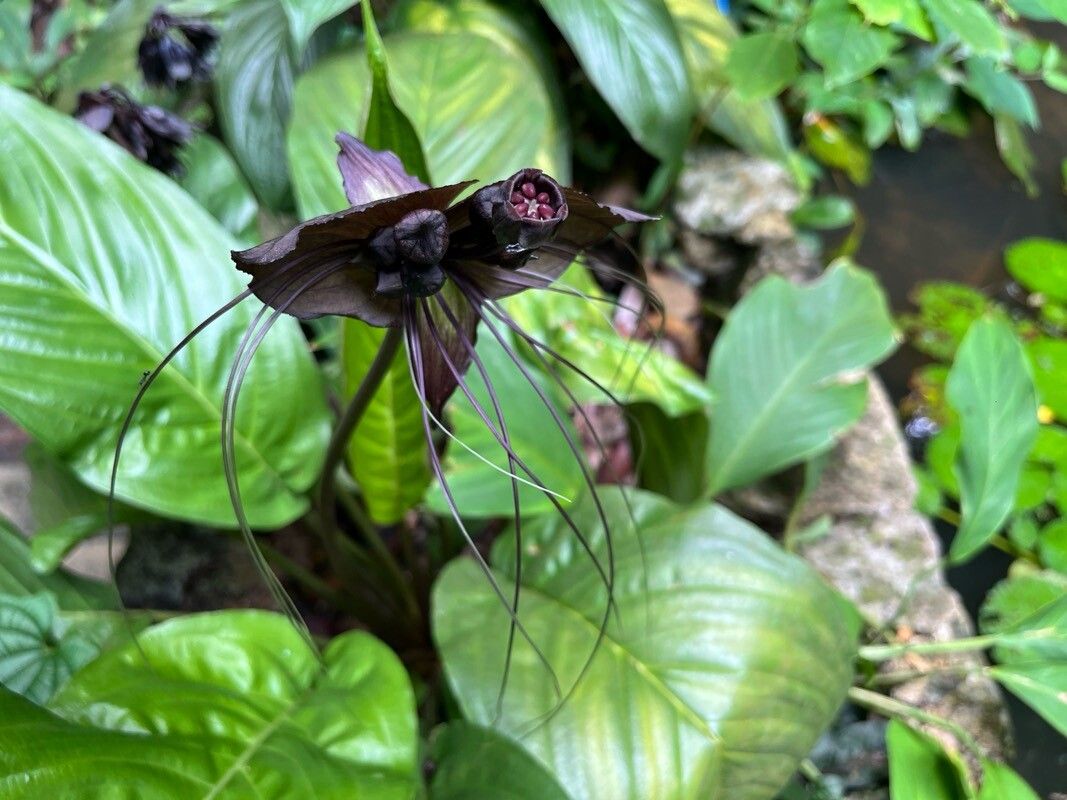
Tacca, Genus, chantrieri, Species,
- Genus & species
black bat flower
Overview
Tacca chantrieri is a tropical perennial in the Dioscoreaceae family grown for its dark purple-black inflorescences with winged bracts and long whisker-like trailing bracteoles. Plants reach 24–36 inches (60–90 cm) tall and 18–24 inches (45–60 cm) wide as a clumping rosette, with new shoots arising from a short branched rhizome. Leaves are oblong-lanceolate, 12–24 inches (30–60 cm) long and 4–6 inches (10–15 cm) wide, glossy dark green, held on petioles 8–12 inches (20–30 cm) long. Each inflorescence consists of a central cluster of 6–25 small purple-black flowers cupped by two pairs of large purple-black involucral bracts 4–8 inches (10–20 cm) wide that flare like wings, plus 6–25 thread-like dark purple bracteoles (filiform bracts) hanging 8–12 inches (20–30 cm) below the flowers. Bloom occurs in flushes of 2–3 weeks during warm months, with mature plants producing 3–6 inflorescences per growing season under tropical conditions. Round green to brown berries 0.4–0.6 inch (10–15 mm) develop after pollination and ripen over 8–10 weeks. The plant goes semi-dormant in winter under cool conditions, with foliage dying back below 60°F (16°C) and resprouting from the rhizome in spring. Cultivated as a tropical container specimen and as a greenhouse and conservatory plant in cool-temperate zones.
Native Range
Tacca chantrieri is native to tropical Southeast Asia, ranging from Yunnan and Hainan in southern China through Thailand, Laos, Vietnam, Cambodia, and northern Malaysia, growing in lowland to mid-elevation moist forest understory at 200–1,500 m (660–4,900 ft). The species occurs in shaded, humid microhabitats along streams and on forest floors with deep leaf litter.Suggested Uses
Used as a shaded specimen plant in tropical container gardens, conservatories, and warm-climate shade beds where humidity stays above 60%. Pairs in collections with other shade-tolerant tropicals (Alocasia, Anthurium, Begonia) and tropical ferns that share similar humidity and warmth requirements. Spaced 18–24 inches (45–60 cm) on center, mature plants need clearance for the wide flower bracts and trailing bracteoles.How to Identify
Appearance
Size & Dimensions
Height2' - 3'
Width/Spread1'6" - 2'
Colors
Bloom Information
Inflorescences emerge from late spring through early autumn (May–September) in tropical zones 10–11, with flushes of 2–3 weeks per inflorescence and 3–6 inflorescences per mature plant per season. Each flower head opens over 7–14 days, with the central cluster of 6–25 small flowers fertile for 3–5 days. The dark coloration deepens to near-black under bright, indirect light and becomes a duller brown-purple in deeper shade or under cooler temperatures.
Detailed Descriptions
Foliage Description
glossy dark greenGrowing Conditions
Sun Requirements
Requires 2-4 hours of direct sunlight daily
• Full Sun: 6+ hours of direct sunlight
• Partial Shade: 3-6 hours of direct sunlight
• Full Shade: Less than 3 hours of direct sunlight
Care & Maintenance
Care Guide
Filtered or part shade (2–4 hours of dappled or filtered light) suits this species; direct midday sun scorches leaves and bleaches the dark flower bracts toward dull brown. Moist, humus-rich soil with a pH of 6.0–7.0 is required; sandy or compacted clay produces smaller leaves and reduced flowering. Watering occurs when the top 1 inch (2.5 cm) of soil dries during active growth (April–September), and water is reduced through autumn as the plant slows. Temperatures of 65–85°F (18–29°C) and humidity above 60% are required for normal growth and flowering, with leaf damage starting at 55°F (13°C). A balanced liquid fertilizer at half strength every 3–4 weeks during the growing season supports vigor; high-nitrogen feed produces leaves at the expense of inflorescences. In zones 9 and colder the rhizome is overwintered indoors at 60–70°F (16–21°C), kept barely moist, and returned outdoors after frost.Pruning
Spent inflorescences are cut at the base of the peduncle once the bracts wither, typically 3–4 weeks after opening; cutting earlier removes potential berry development. Old yellowing leaves are removed at the petiole base after they wilt naturally in late autumn; cutting healthy leaves before dormancy reduces rhizome storage reserves. The rhizome can be divided every 4–5 years when the clump becomes crowded.Pruning Schedule
Prune: October–November
fall
Container Growing
Suitable for container growing
Minimum container size: 3 gallons