Tacca, Genus, spp., Multiple species,
- Genus
- Multiple species
bat flower
Old and New World tropics; greatest diversity in Southeast Asia
Overview
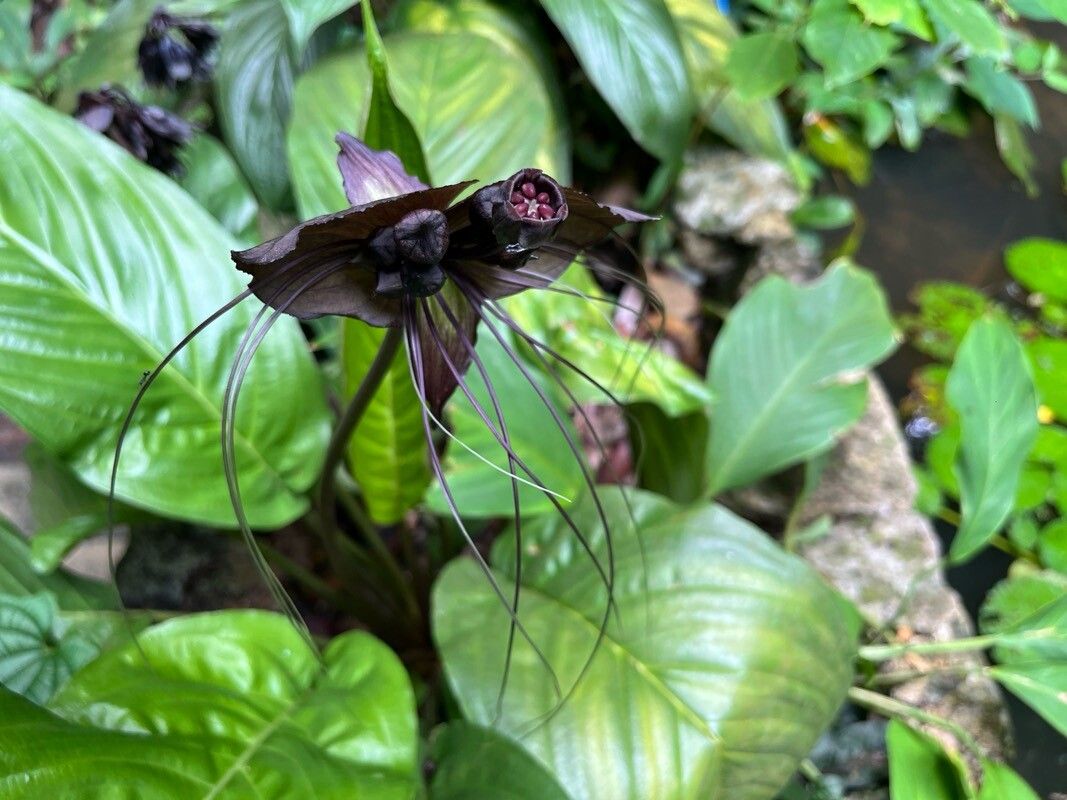
Tacca is a genus of about 15 species of rhizomatous and tuberous herbaceous perennials in the yam family, native to tropical forest understories. Plants form basal clumps of long-petioled leaves that are entire, lobed, or deeply divided, reaching 12-48 inches (30-120 cm) tall and 12-24 inches (30-60 cm) wide. The inflorescence is an umbel of small flowers held above two pairs of involucral bracts and a fringe of long, thread-like filiform bracteoles that hang to 10 inches (25 cm); flower and bract color ranges from green and white to deep maroon-black across the genus. In T. chantrieri the bracts are near-black, while T. integrifolia carries white to pale purple bracts. Fruit is a fleshy berry containing numerous seeds. Several species spread by branching rhizomes to form colonies, and T. leontopetaloides produces a starchy tuber historically processed into Polynesian arrowroot. Growth is continuous in frost-free conditions, with some species dying back to the tuber during dry seasons. Plants require consistently warm, humid, shaded conditions and are damaged below about 50F (10C), which limits outdoor use to tropical and subtropical climates or heated greenhouses. Foliage marks easily in dry air or direct midday sun, showing brown leaf edges.
Native Range
Tacca species occur across the Old and New World tropics, with the greatest diversity in Southeast Asia and southern China. The range extends to northern Australia, the Pacific islands, tropical Africa, and parts of tropical America.Suggested Uses
Grown as a container and conservatory plant in temperate regions and as a shaded understory perennial in tropical gardens. T. leontopetaloides is also cultivated as a starch crop. The fringed inflorescences are used in tropical shade and woodland plantings.How to Identify
Appearance
Size & Dimensions
Height1' - 4'
Width/Spread1' - 2'
Bloom Information
Flowering occurs mainly in the warm, humid months, chiefly summer in cultivation, and can continue intermittently year-round in the tropics. Each flower cluster persists for several weeks. The fringed bracts and pendulous bracteoles remain showy after the small flowers fade.
Detailed Descriptions
Flower Description
green to maroon-black or whiteFoliage Description
greenGrowing Conditions
Sun Requirements
Needs bright indirect light. Keep it out of direct sun, which can scorch the leaves.
• Bright indirect light: a bright spot near a window, with no direct sun on the leaves
Care & Maintenance
Care Guide
Grow in bright, indirect light or dappled shade with daytime temperatures of 65-80F (18-27C) and high humidity. A loose, humus-rich, free-draining mix kept evenly moist during active growth suits the genus, with watering eased back as growth slows. Waterlogging rots the rhizome, and exposure below 50F (10C) damages foliage and growing points. Light feeding through the growing season supports steady growth. In dry air the leaf margins turn brown, so humidity above 60 percent helps maintain intact foliage.Pruning
Pruning is limited to removing spent flower stalks and damaged or yellowing leaves at the base. No structural pruning is needed. Clumps can be divided in spring to manage size and propagate.Container Growing
Suitable for container growing
Minimum container size: 3 gallons